guide
Sagrada Familia History Across an Unfinished Century
A building made by more than one moment
Sagrada Familia matters historically because it resists the usual idea of a landmark as a finished object from one date. Its story begins in the late nineteenth century, is transformed by Antoni Gaudi, and continues through later generations of construction and interpretation. That makes the building a rare public record of architectural intention surviving beyond one lifetime.
Barcelona is part of the meaning
The basilica belongs to Barcelona's architectural identity, but not in the same way as a completed civic monument. It is a religious project, a tourism magnet, a neighborhood presence, and a symbol of Catalan Modernisme's ambition. Its long presence in the city means residents and visitors encounter not only a building, but also a continuing debate about completion, authorship, and public value.
Gaudi's role is central but not simple
Gaudi gave the project its most powerful architectural direction, especially through structure, geometry, nature references, and symbolic program. But the building's history did not end with him. That is why the page should avoid treating Sagrada Familia as a simple author monument. It is both Gaudi's project and a collective continuation shaped by changing tools, interpretations, funding, and public expectations.
Why unfinishedness became part of fame
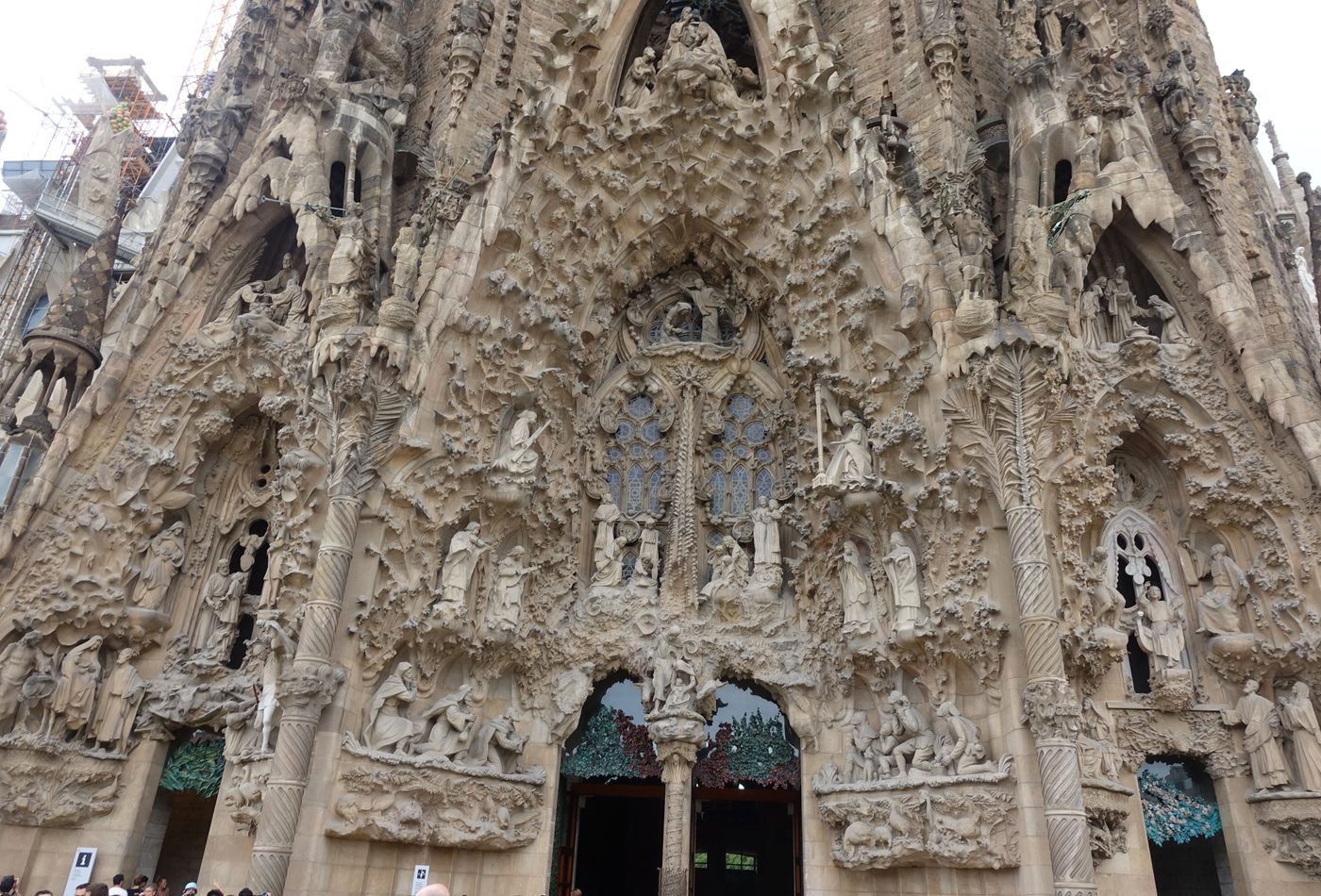
Many buildings are famous despite being unfinished or altered; Sagrada Familia is famous partly because its unfinishedness is visible and meaningful. Cranes, newer stone, evolving surfaces, and changing completion narratives all affect how people see it. The slow timeline turns construction into public memory. Visitors do not only ask what the building is; they ask what it is becoming.
Religious program and public spectacle
The basilica is a church, but its public role extends beyond worship. Its facades, towers, and interiors carry religious narratives into a global tourist image. That double role creates tension. A sacred building has to support devotion and symbolism, while a global landmark is photographed, queued for, explained, and circulated online. Sagrada Familia sits exactly inside that tension.
Historical comparison
Compare Sagrada Familia with Notre-Dame de Paris and Florence Cathedral. Each ties religious architecture to city identity, but the timelines differ. Notre-Dame carries restoration and medieval memory; Florence Cathedral centers on a completed dome breakthrough; Sagrada Familia keeps construction itself in view. That difference explains why its history feels unusually active.
What the long timeline changes
The long timeline changes the reader's standard of judgment. A short project can be judged mainly by the original brief and finished result. Sagrada Familia asks a harder question: what happens when design intent has to pass through later technologies, later craftspeople, later budgets, and later public expectations? That is why historical context belongs on the page. The building's meaning is produced by continuity and interruption together.
Historical reading check
The history should change what the reader sees. The branching columns should no longer seem only beautiful; they should read as evidence of Gaudi's structural imagination. The mixed surfaces should no longer seem only busy; they should read as a record of construction across time. The unfinished state should become part of the building's historical meaning, not a footnote.