guide
The Shard London Bridge Viewing Notes
Begin from London Bridge
The best first read of The Shard is from London Bridge or the nearby river approaches. From there the tower is neither a remote skyline image nor an abstract object. It rises out of a working transport district and appears against water, bridges, older masonry, and dense street movement. This first view helps explain why the tower is powerful and controversial at the same time.
Use distance before the base
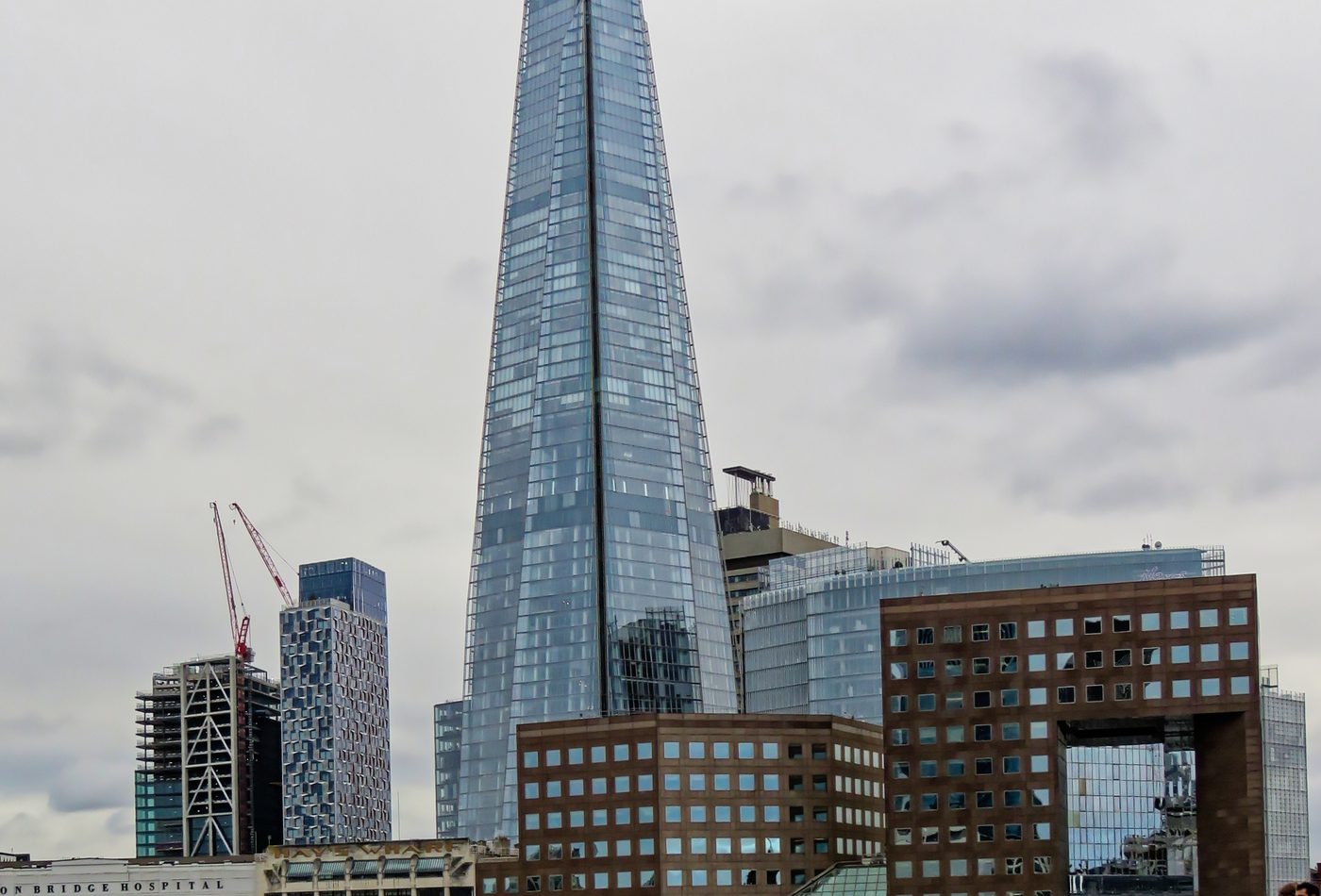
Do not start only at the entrance. The Shard is most legible from a little distance, where the taper and crown can be seen together. Step back enough to see the whole vertical figure. Notice how the glass planes narrow upward and how the top refuses to become a simple roof. That distant reading gives you the diagram before the base becomes complicated.
Then test the base condition
After the skyline view, move closer to London Bridge Station and the surrounding streets. The base is where the project has to stop being only an image. Look for how pedestrians, entrances, service edges, neighboring buildings, and street crossings meet the tower. The design question here is practical: can a dramatic vertical landmark still handle a dense ground-level city?
Watch the glass change
The facade changes with light and weather, so a visit should not treat the surface as one color. On overcast days the tower can become pale and grey. In low sun, it can catch warm reflection. At night, it becomes part of London's illuminated skyline. These changes are not cosmetic. They explain why glass is the building's primary architectural language.
Make three useful photographs
Make one wide river or bridge view that shows the tower in the city, one close view of the glass planes near the base, and one distant skyline view from another part of London. Those three images prevent the visit from becoming only a height souvenir. They record context, material, and public visibility, which are the main evidence needed to understand the building.
Compare with older London landmarks
Before leaving, compare The Shard with St Paul's Cathedral, Tower Bridge, and 30 St Mary Axe if those views are available in your route. The point is not to decide which landmark is better. It is to see how different eras use height, profile, material, and public memory. The Shard's sharp glass identity becomes clearer when measured against domes, bridges, and older civic forms.
Observation route
Use a simple order: bridge view, river view, base condition, glass close-up, then a distant skyline check. That route keeps the visit architectural. It moves from image to evidence and back to city scale. The Shard is easy to recognize quickly, but it becomes more useful when you can explain how its taper, crown, material, transport setting, and skyline role reinforce one another. If time is short, choose two opposite distances instead of trying to cover every angle. A close street view shows the pressure of the station district, while a remote view from the Thames or another skyline point shows whether the shard-like profile actually clarifies orientation. Holding those two readings together is the best way to avoid treating the tower as only a view deck or only a controversy.