guide
The Shard Facts: London Height, Station, and Skyline
A tower tied to a station district
The Shard is a skyscraper at London Bridge, completed in 2012 and designed by Renzo Piano Building Workshop. The first fact to hold onto is not only its height or its glass skin. It stands in one of London's oldest and busiest crossing districts, beside rail, Underground, hospital, market, river, and bridge routes. That setting makes the tower read as infrastructure as much as object: it gathers views, movement, commercial address, hotel use, restaurants, and observation into one vertical marker.
The profile is deliberately incomplete
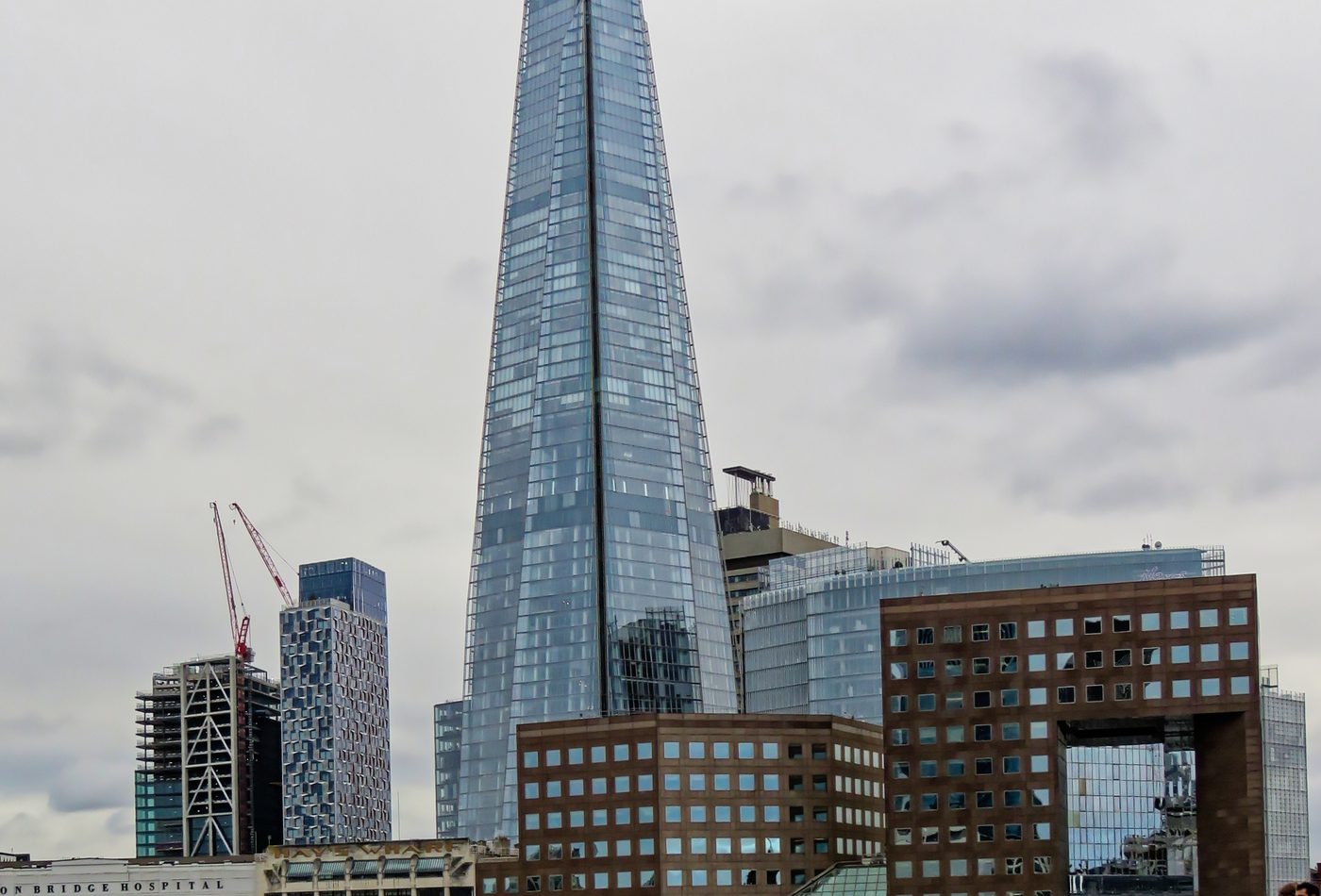
The building's tapered form is made from sloping glass planes that narrow as they rise. The top does not close into a neat cap, which is why the tower appears splintered rather than sealed. That incomplete-looking crown is central to the identity of the building. It lets the profile feel lighter than a flat-topped office slab, while still making a strong silhouette from the river, from London Bridge, and from distant parts of the city.
Glass is the main public material
The recorded material palette is glass and steel, but glass carries most of the public reading. It reflects grey weather, sunset, blue sky, nearby roofs, and night light, so the tower changes more than a stone monument would. The surface also makes the building both visible and elusive: it dominates many views, yet its edges can dissolve in cloud or haze. That dual effect is why the material fact matters.
Mixed use shapes the section
The Shard is not a single-purpose office tower. Its vertical stack includes workplace, hotel, restaurants, viewing functions, and service systems. That matters because the tower is experienced at several levels: commuters read it from the base, visitors read it as a view machine, and the city reads it as a skyline event. The building's architecture is therefore not only the facade. It is a section of uses pulled upward over a transport node.
The London question
The Shard belongs to a continuing London debate about tall buildings in a historically layered city. It is much taller than many neighboring structures and can be seen from far beyond Southwark. That visibility is not a side effect. It is part of the project. A useful fact page should make readers ask how a new tower negotiates old routes, river views, protected sightlines, financial pressure, tourism, and the desire for a recognizable contemporary skyline.
What to notice first
Start with three visible clues: the tapering glass planes, the open-looking crown, and the contrast with older London roofs and masonry. Those details explain the building faster than a height statistic. The taper makes the tower legible from far away; the crown gives the silhouette its name-like force; and the skyline contrast shows why the project is both memorable and contested.
Why it belongs in the atlas core
The Shard is useful for this atlas because it teaches how a contemporary skyscraper can operate as transit landmark, real-estate signal, tourist device, and skyline argument at the same time. Compare it with Burj Khalifa for taper and height spectacle, 30 St Mary Axe for London tower identity, and Centre Pompidou for architecture that turns a public building into an urban signal.