guide
Casa Batllo Street-to-Roof Visit Notes
Start from across the street
The best first read of Casa Batllo is from across the street, where the facade can be seen as one vertical composition. Look at the roofline, balcony rhythm, lower stone forms, and ceramic surface before isolating details. From this distance the house still reads as part of the street, which matters because its originality works within an urban row rather than outside it.
Then study the balconies
Move your attention to the mask-like balconies. They are small enough to be details but strong enough to shape the whole facade. Compare their dark openings with the lighter ceramic field around them. This is where the building's organic reading becomes precise: the balconies feel animated, but they still sit within a disciplined facade rhythm.
Use the roof as a second reading
Do not treat the roof as a separate photo moment. Read it after studying the facade. The scale-like roof changes the identity of the entire house by giving the top a creature-like finish. Look for how color, curve, and profile complete the vertical movement that begins lower on the facade. The roof makes the building memorable from a distance and stranger up close.
Look for material transitions
Casa Batllo rewards attention to transitions between ceramic, stone, glass, and iron. These materials do not meet as neutral construction layers. They shift the mood from carved lower levels to reflective surface, balcony edge, and roof texture. A visitor who studies only the color misses how much of the design depends on material change and handcrafted edges.
Give the blue lightwell real time
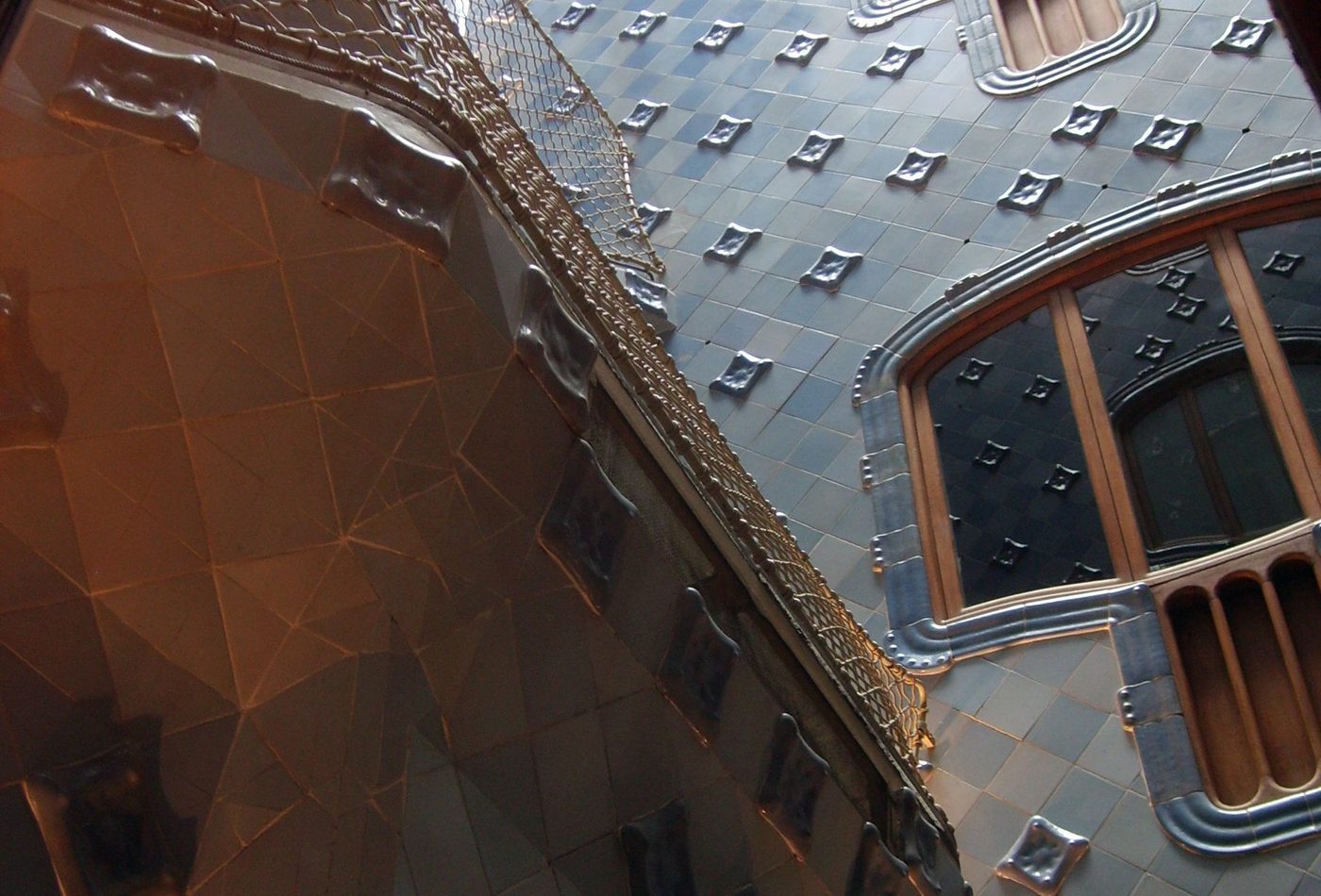
Inside, the blue lightwell should be treated as a major architectural event, not a secondary feature. It shows how daylight, color, and vertical circulation are managed within the house. The lightwell helps explain why Casa Batllo is more than a facade. It brings the same organic discipline into interior experience and makes domestic space feel designed from surface to atmosphere.
Make four useful photographs
Make one wide facade image, one balcony close-up, one roof profile, and one lightwell or interior light study. Those four photographs preserve the building's main architectural evidence: street composition, crafted detail, skyline identity, and interior atmosphere. They also prevent the visit from collapsing into a single colorful postcard view.
Watch the street context
Before leaving, look back at the neighboring facades. Casa Batllo is strongest when its difference is measured against the urban row. The house does not need an open plaza to be memorable; it uses a normal street condition as pressure. That contrast makes the facade more legible and keeps the visit tied to Barcelona rather than to a detached object.
Compare before leaving the Barcelona group
After studying Casa Batllo, compare it with Sagrada Familia and Casa Mila. The point is not to rank Gaudi buildings. It is to see how similar instincts change across sacred, domestic, and apartment-building programs. Casa Batllo is especially useful because it shows Gaudi's organic language compressed into a street facade and a house interior.
Slow-looking route
Use a simple order: whole facade, balconies, ceramic surface, roofline, material transitions, then blue lightwell. That route keeps the visit architectural. It moves from public image to detail and then into interior light. Casa Batllo is easy to enjoy quickly, but it becomes more useful when the visitor can explain how craft, color, structure, and domestic space reinforce one another.