guide
Casa Batllo Design: Skin, Lightwell, and Roofline
The design turns a house into an organism
Casa Batllo is powerful because it keeps the scale of a city house while making the building feel organic. The design does not rely on one huge gesture. It works through facade surface, balcony shape, roof profile, interior light, and handcrafted detail. The result is a building that feels animated without losing its basic urban role on a Barcelona street.
Facade rhythm replaces normal repetition
An ordinary residential facade often depends on repeated windows, floors, and balcony lines. Casa Batllo bends that expectation. Openings seem softened, balconies become mask-like, and the ceramic skin disrupts flat repetition. Yet the facade is not chaotic. It keeps enough rhythm for the house to remain legible as a building, while every detail resists the dullness of a standard apartment elevation.
The roof completes the composition
The scale-like roof is not just a picturesque top. It changes how the whole facade is read. The body of the house appears to rise into a textured crest, so the building gains a figure-like quality. This roof-to-facade relationship is central to the design. Without it, the facade could feel like a decorative surface; with it, the house becomes a full vertical composition.
Materials carry movement
Ceramic, stone, glass, and iron each carry a different kind of movement. Ceramic creates color shifts across the facade. Stone gives openings a soft carved quality. Glass catches street light and reflection. Iron sharpens balconies and detail edges. The design succeeds because the materials do not simply cover the building. They make the building's movement visible at several scales.
The interior lightwell proves the idea is spatial
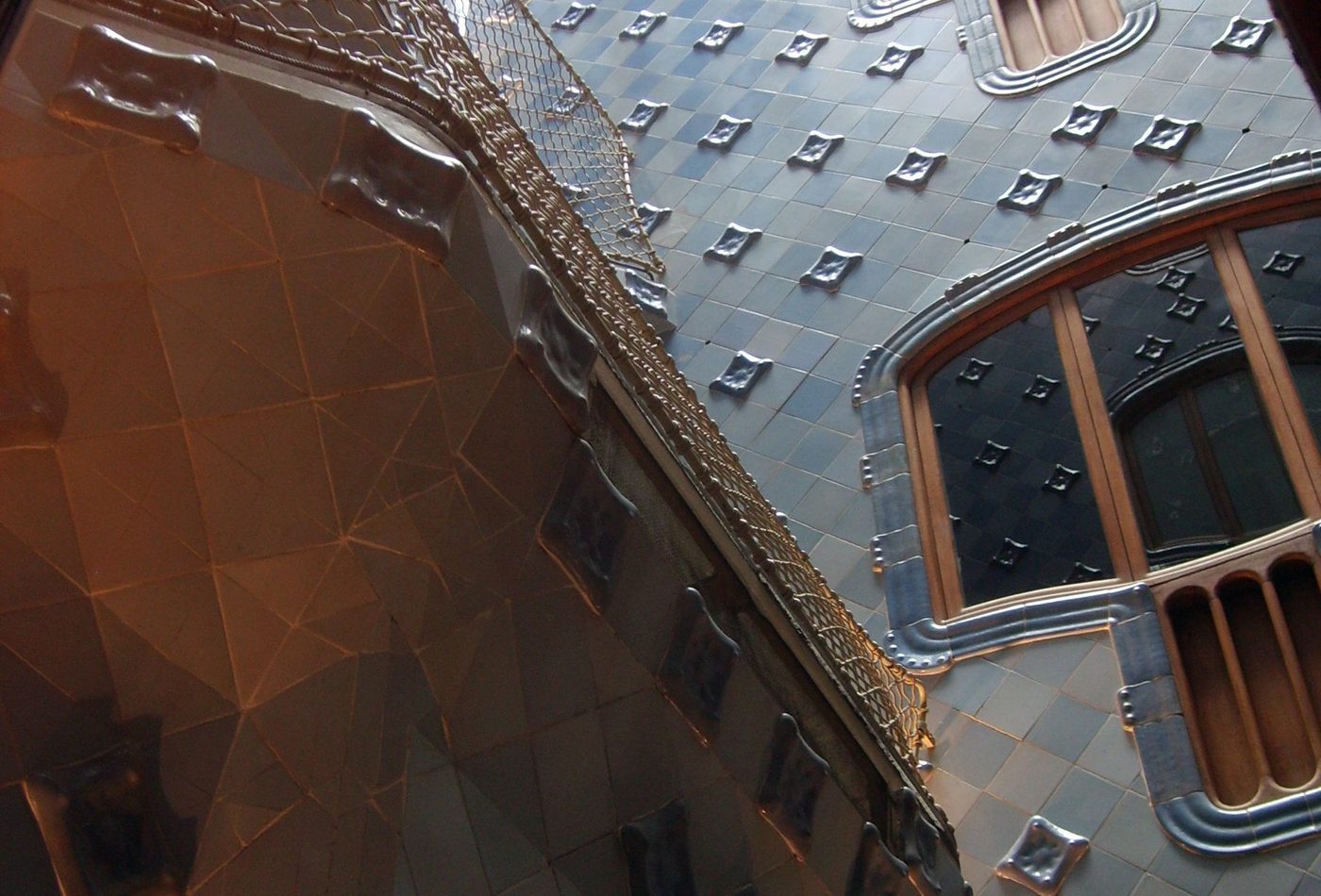
A design analysis should not stop outside. The blue lightwell proves that Casa Batllo's organic language also works through interior atmosphere. It manages daylight, color, and vertical movement inside the house. This matters because the project is not only a facade experiment. It uses light and craft to reshape domestic experience, turning circulation and rooms into part of the same architectural language.
Controlled fantasy is the key
Casa Batllo can invite words like dreamlike or fantastical, but those words are too loose unless they are tied to control. The building's value comes from disciplined craft: repeated balcony positions, managed openings, a coherent roof profile, and a material palette that keeps the whole together. The fantasy works because it is organized through construction decisions that can be seen and tested.
How to test the design from photos
Photographs are useful if they are asked to answer specific design questions. A wide facade image tests whether the roof, balconies, and ceramic field hold together as one composition. A close balcony image tests how iron and shadow make the mask-like forms legible. A lightwell image tests whether the interior continues the same design discipline rather than acting as a separate attraction.
Design reading check
A good design reading should explain how the facade, roof, balconies, ceramic surface, and blue lightwell work as one system. The point is not that Casa Batllo is strange. The point is that Gaudi takes domestic architecture and makes every surface, opening, and light condition participate in a larger organic reading.