guide
Burj Khalifa Facts: Height, Plan, and Dubai Setting
Height is only the entry point
Burj Khalifa is a supertall skyscraper in Dubai completed in 2010 and designed by Skidmore, Owings & Merrill with Adrian Smith as consulting design partner. The public fact everyone remembers is height, but the architectural fact that matters more is how that height is organized. The tower is not simply a stretched glass needle. It is a vertical district with a structural plan, a mixed-use stack, and a staged relationship to Downtown Dubai.
The Y-shaped plan does real work
The tower's triple-lobed Y-shaped plan is one of its core facts. It is often described through floral and Islamic geometric references, but it is also a practical high-rise device. The three wings help give the tower stability, views, and a clear stepping rhythm as the building rises. This plan makes the skyscraper legible from above, from the skyline, and from the ground, where the tower has to resolve back into entrances, water, landscape, and boulevards.
The buttressed core is the structural clue
Burj Khalifa's structural system is usually described as a buttressed core. That means the tower is organized around a strong central core supported by three wings that brace one another. This is the fact that turns extreme height from a number into an architectural reading. The stepped form and narrowing profile are not arbitrary decoration. They help manage structure, wind, usable floor plates, and the visual experience of a tower that rises far beyond the scale of surrounding buildings.
Mixed use shapes the vertical section
The building includes residential, hotel, office, observation, service, and public-facing uses within one vertical stack. That mixed-use condition matters because it changes how the tower is experienced. Some people encounter it as an address, some as a hotel, some as a viewing platform, and many as an urban marker seen from far away. A fact page should not flatten those roles into one tourist claim. The tower's architecture is the section as much as the facade.
The envelope answers climate and image
Glass, aluminum, stainless steel, concrete, and reflected desert light shape the tower's public face. The exterior has to perform in heat, glare, dust, and wind while also creating a clean skyline image. That dual demand explains why the facade should be read as both environmental envelope and symbol. The tower can look like a polished object, but it is also a climatic negotiation between cooling, shading, reflection, maintenance, and extreme height.
Downtown Dubai is part of the fact set
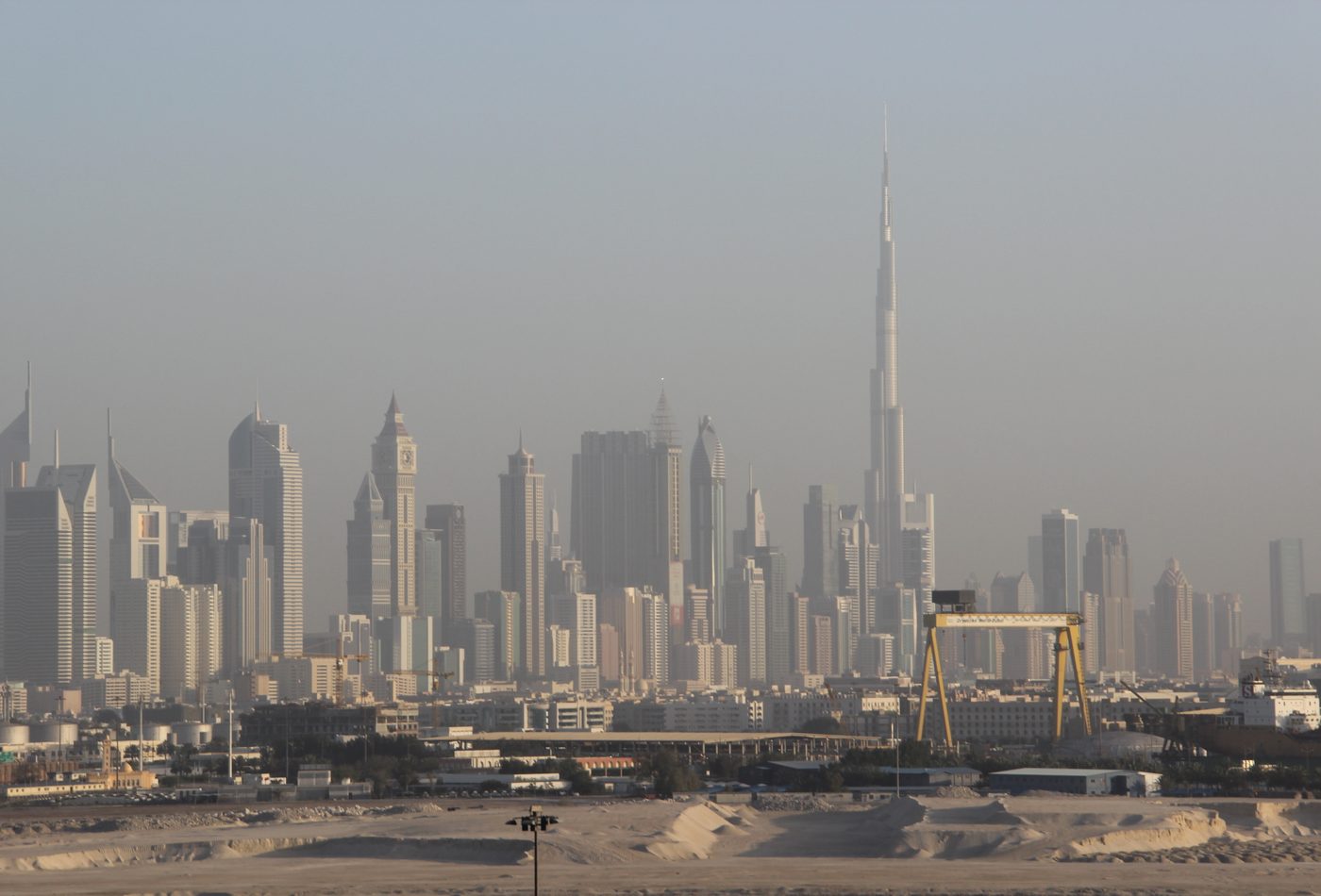
Burj Khalifa stands at the center of a larger development with water features, retail, hotels, promenades, and surrounding towers. That setting is essential. The building was not meant to be read as an isolated engineering trophy on an empty site. It anchors a branded district and turns height into a wayfinding device, real-estate signal, visitor destination, and city image. The skyline fact and the urban development fact belong together.
What to notice first
Start with the Y-shaped plan, the stepped setbacks, and the way the tower meets the district below. Those clues explain more than a height statistic. The plan reveals structural strategy; the setbacks reveal how the tower changes as it rises; and the base shows how spectacle becomes an urban arrival sequence. Burj Khalifa belongs in the core atlas because it teaches how extreme height depends on structure, mixed use, climate, and city branding at once.