A flying buttress is an exterior masonry support that carries roof or vault thrust outward and downward; compare the arch, pier, buttress, and Gothic examples.
A flying buttress is an exterior masonry support that carries the sideways thrust of a high roof or vault outward and downward into a separate pier. It is called flying because the arched support leaps across open space instead of sitting as a solid wall from the roof to the ground.
Load path in plain English
Read the system in five parts: the vault or roof pushes outward, the upper wall receives that push, the flying arch carries the force across open air, the outer pier takes the load, and the ground receives it. That load path lets a Gothic wall open up for taller windows while still resisting the pressure of stone vaulting.
How it differs from nearby terms
A buttress can be any mass that braces a wall. A flying buttress is more specific because an arch spans from the upper wall to an outer support. It is not just decoration, and it is not the same as a pointed arch, ribbed vault, pier, or column, although those parts often appear together in Gothic buildings.
Examples and limits
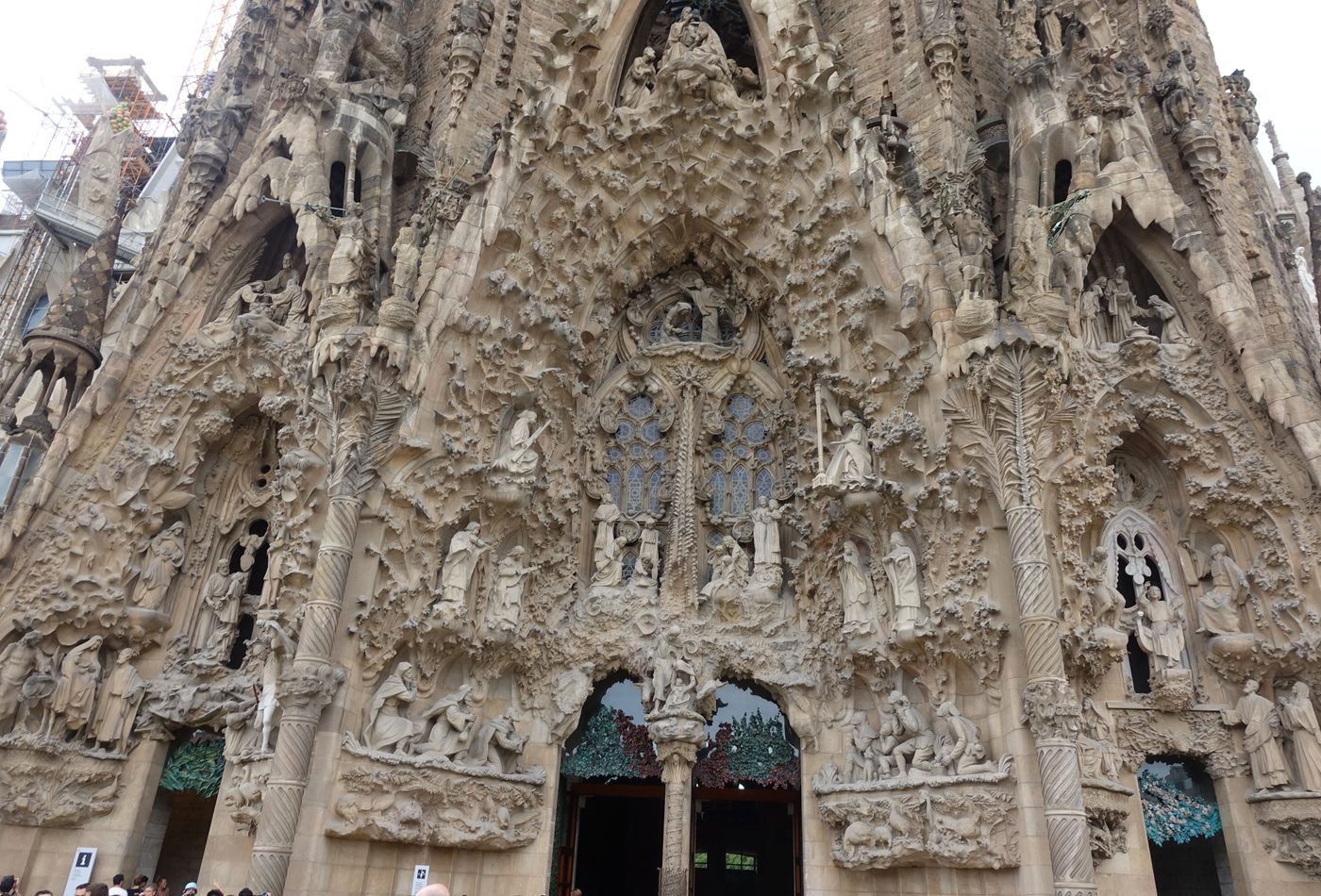
Notre-Dame de Paris is the clearest atlas example for seeing exterior flying buttresses around the nave and choir. Sagrada Familia is useful as a later comparison because it mixes Gothic inheritance with Gaudi's own structural experiments. The term should not be applied to every dramatic exterior support; the key test is whether the support transfers vault or roof thrust outward through an arched span.
How to spot one
Stand back from the wall and look for a gap. A flying buttress usually has an arched piece crossing open air from the upper wall to an outer support. The outer pier may look heavy because it receives force. The upper wall can then carry larger openings, higher vaults, or thinner masonry than a solid wall would allow.
Why it matters
The flying buttress matters because it turns structure into a visible reading tool. It shows how Gothic builders handled height, light, stone weight, and sideways thrust. Once the load path is clear, a reader can compare churches more carefully: not by asking which one looks ornate, but by asking how each wall, vault, pier, and window solves the pressure of building upward.
Search clue to carry forward
The strongest search clue is the visible transfer of force. If the support does not carry pressure across open air into an outer mass, the term is probably too loose. Use that test before comparing Gothic examples, because it keeps the definition tied to structure rather than dramatic exterior shape alone.