guide
Tower Bridge History Beyond the Postcard View
A river problem became a civic image
Tower Bridge's history begins with a practical urban problem. London needed another Thames crossing in the east, but the river still had to serve shipping and dock-related movement. The bridge therefore had to solve traffic and navigation together. Its public success comes from the fact that this technical answer became a city image. What began as infrastructure became one of London's most repeated symbols.
Late Victorian London shaped the bridge
The bridge belongs to a city balancing industrial capacity, imperial confidence, public ceremony, and historic self-image. A movable bridge could have looked purely mechanical, but London gave this one towers, masonry dressings, and a dramatic profile. That choice tells us something about the period. Infrastructure was expected to work, but the most visible infrastructure also had to explain civic ambition and cultural continuity.
The moving span made history visible
The bascule action is not a minor technical footnote. It is the historical reason the bridge exists in this form. The opening deck shows the old pressure between road traffic and river traffic. Even when the bridge is closed, its towers and central leaves remind viewers that the Thames was not just scenery. It was a working corridor that demanded architectural and engineering negotiation.
Why the postcard view can mislead
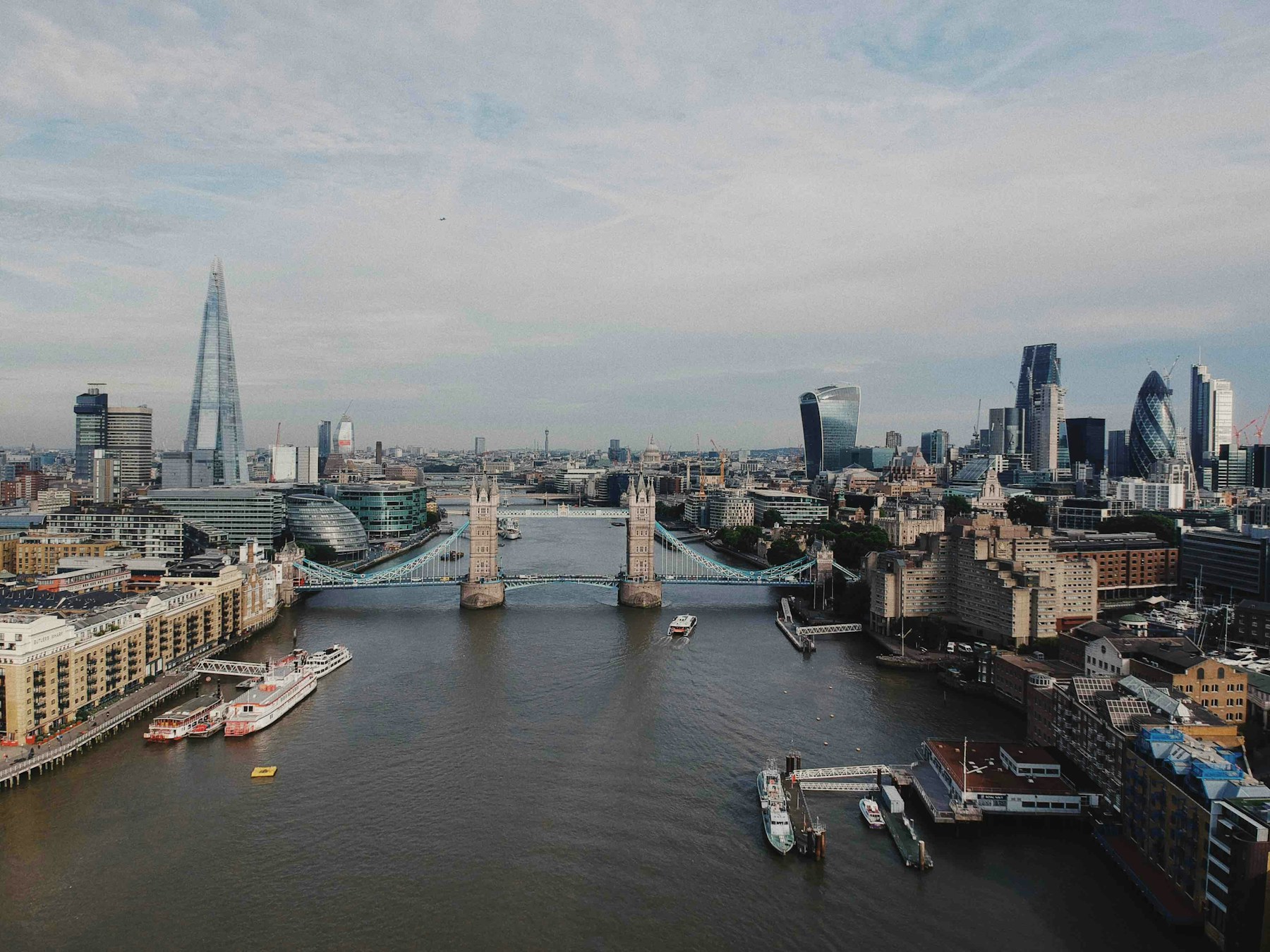
Tower Bridge is so familiar that it can be mistaken for a static monument. The postcard view often hides the working logic: moving leaves, high walkways, machinery, approaches, and river clearance. A better history reading uses the famous view as evidence, not decoration. The bridge became famous because it made a complex technical compromise memorable enough to enter public imagination.
The skyline around it keeps changing
Tower Bridge has not stayed visually fixed even though the bridge itself remains recognizable. The London skyline around it has changed sharply, with newer towers, office districts, river walks, tourist routes, and changing traffic patterns. This makes the bridge a useful historical marker. It holds a Victorian civic image inside a much newer metropolitan frame, so every wide view is also a comparison across periods.
Public access changed the meaning
The bridge is not only seen from outside. Its walkways and internal visitor routes let people study the structure from within and above the roadway. That public access changes the historical meaning because the bridge becomes an educational object as well as a crossing. Visitors can read machinery, view, tower mass, and city context rather than only consuming the bridge as a background image.
Historical reading check
A useful history page should make Tower Bridge feel less automatic. The key shift is from landmark name to negotiated infrastructure. Its history links east London movement, Thames navigation, late Victorian civic image, movable engineering, and a skyline that keeps changing around it. Once those parts are visible, the bridge becomes more than a decorative London icon.