guide
Tokyo International Forum History as Civic Infrastructure
A 1990s civic interior that kept working
Tokyo International Forum is historically important because it made a large civic interior feel public, useful, and technically expressive in one of the world's densest cities. Opened in 1996, it belongs to a period when global cities were experimenting with cultural and convention complexes as urban infrastructure. The building's long-term value is not only its image. It has continued to work as a place where events, passage, gathering, and architectural looking overlap.
Rafael Vinoly's competition design
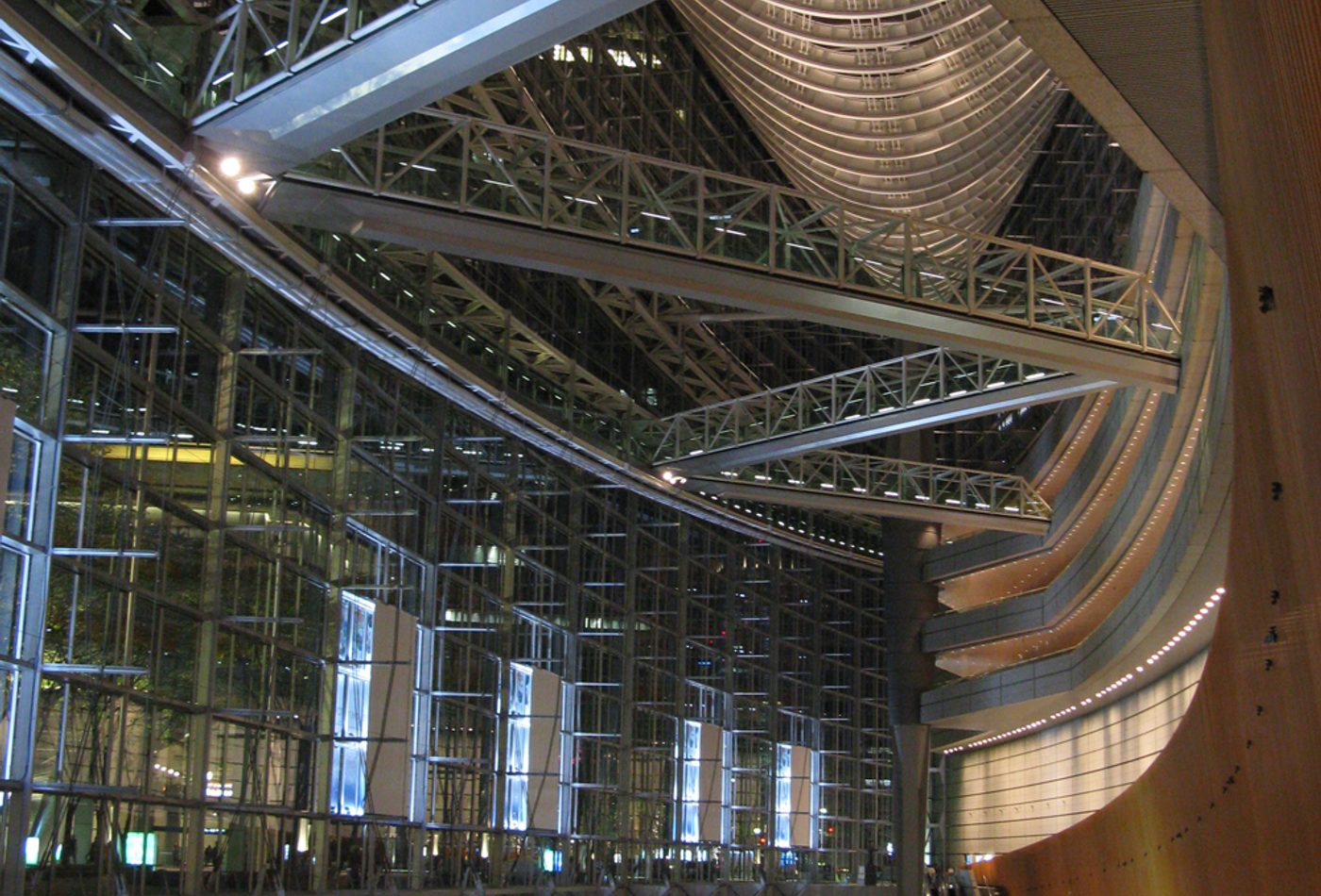
Rafael Vinoly's authorship matters because the project is a clear architectural proposition, not just a program container. The design turns the Glass Hall into the public heart of the complex and uses structure to make a huge interior understandable. That decision gave the building a durable identity. Many event complexes disappear into anonymous halls and back-of-house systems; Tokyo International Forum is remembered because its circulation and structure are the civic face.
A site shaped by transit and redevelopment
The site near Yurakucho and Tokyo Station gives the building its historical force. It stands where rail movement, office districts, shopping streets, and cultural events meet. That location means the complex has always had to operate as part of the city, not only as a destination. Its history is therefore tied to Tokyo's ability to fold large public programs into tight, transit-rich districts without making them feel sealed off.
High-tech after the heroic phase
The building also belongs to the history of high-tech and structural expression after the louder experimental phase of the 1970s and 1980s. Tokyo International Forum does not rely on bright service pipes or industrial provocation. It absorbs technical expression into an elegant civic interior. That makes it historically useful: it shows how exposed structure and transparency could become less rebellious and more institutional by the 1990s.
Recognition came from everyday performance
The project has received long-term recognition because it remained useful and memorable beyond its opening moment. Its Glass Hall is not just a dramatic photograph; it is a working circulation space that people can repeatedly experience. That distinction matters in architectural history. Some icons fade when their novelty wears off, but buildings that organize public life well can gain authority over time. Tokyo International Forum belongs in that second category.
Publicness is the central debate
The main historical debate is what kind of publicness a large cultural and convention complex can offer. Tokyo International Forum is not a park or a street, but its transparent hall, routes, and event edges create a form of interior public life. The building invites questions about access, programming, security, and civic use. Its importance lies partly in making those questions visible through architecture rather than hiding them behind blank event-center walls.
Historical reading check
A useful history page should leave Tokyo International Forum looking less like a glass spectacle and more like a civic machine. It should be read as a 1990s cultural complex, a transit-adjacent public interior, a structural expression landmark, and a durable piece of Tokyo urban infrastructure. If those layers remain visible, the building becomes a richer case study than a simple atrium photo.