guide
Tokyo International Forum Design: Ribs, Glass, and Circulation
The design makes circulation the event
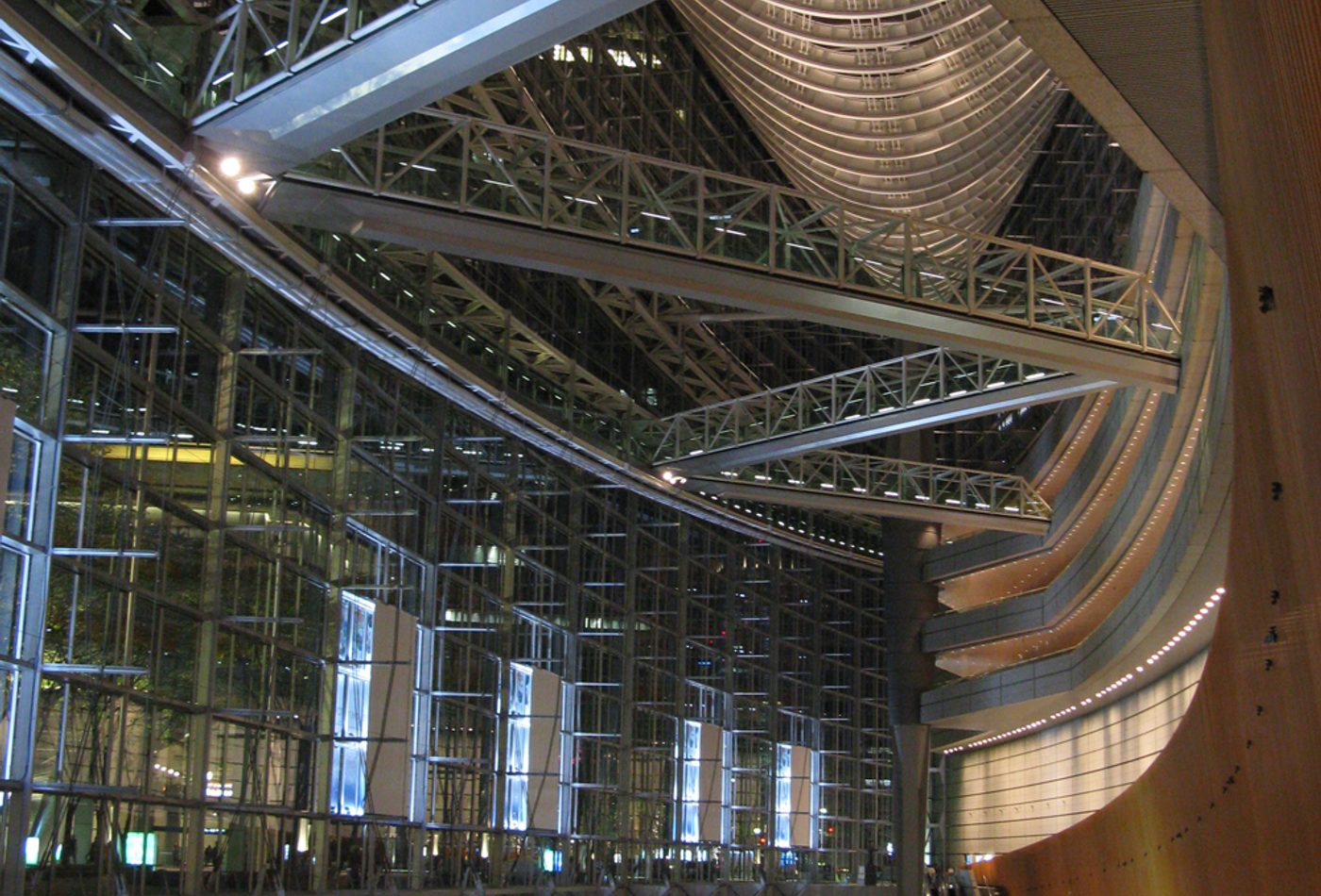
Tokyo International Forum is strongest when read as moving architecture. The Glass Hall does not simply contain a lobby; it turns circulation into the main public event. Bridges, stairs, elevators, trusses, glass walls, and long views make the act of moving through the building visible. This is why the complex feels more civic than a sealed convention center. It lets visitors see one another, the structure, and the city at the same time.
The Glass Hall works by section
The building's most important design drawing is not a flat facade but a section through the atrium. Height, ribs, bridges, floors, entries, and light all stack together. That sectional clarity lets a very large interior feel understandable. The hall can be read from below, from a bridge, from an upper level, or from the side, and each view explains another part of the spatial system. The design rewards vertical looking as much as forward walking.
The ship comparison is useful but limited
Many people compare the Glass Hall to a ship. The comparison is helpful because the ribs and long hull-like volume make the interior feel engineered and directional. It becomes weak if it turns the building into a novelty image. The better design reading asks how the ribbed form organizes light, span, acoustic scale, route choice, and public orientation. The point is not that the building looks like a ship; it is that structure gives the interior a memorable public body.
Transparency is controlled complexity
The glass envelope creates openness, but the design is not minimal. It is full of layers: structural members, bridges, stairs, city views, event flows, signage, reflections, and people. The value of the design is that these layers remain readable. A less disciplined building could become visual clutter. Tokyo International Forum turns the complexity of a big public program into an ordered interior landscape, using transparency as a wayfinding tool.
Structure performs without shouting
The building belongs near high-tech architecture, but it does not expose pipes and services as loudly as Centre Pompidou or Lloyd's Building. Its technical expression is quieter: steel ribs, glass hall, bridge routes, and carefully framed movement. That restraint matters. It lets the structure be dramatic while still serving civic clarity. The building feels engineered, but it also feels accessible, which is why it has aged as a public interior rather than only as a 1990s design statement.
The city enters through the edges
Tokyo International Forum uses its site by allowing the city to press against the building's transparent edges. People approach from rail, office streets, shopping routes, and event entrances. The design has to absorb that pressure while maintaining the calm of the central hall. This is a difficult balance. The building is not an isolated object in a plaza; it is a filter between dense urban movement and scheduled cultural programs.
Design comparison
Compare Tokyo International Forum with Centre Pompidou, Eiffel Tower, and Louvre Pyramid. Centre Pompidou externalizes systems and movement onto the facade; the Eiffel Tower makes pure structure public; the Louvre Pyramid uses glass geometry to organize entry; Tokyo International Forum makes a transparent structural interior into the main civic experience. The comparison shows why this building should be read through circulation and section, not only through its glass skin.