guide
Tokyo International Forum Facts: Glass Hall and Rail-Side Site
The main fact is an interior city room
Tokyo International Forum is a civic and cultural complex in Tokyo designed by Rafael Vinoly and opened in 1996. The first useful fact is that its most memorable architecture is inside, not only on the street. The Glass Hall creates a vast public interior between conference halls, performance spaces, rail lines, offices, shopping streets, and the dense movement of central Tokyo. It works as a civic room inserted into a city where open interior public space is especially valuable.
The Glass Hall gives the building its identity
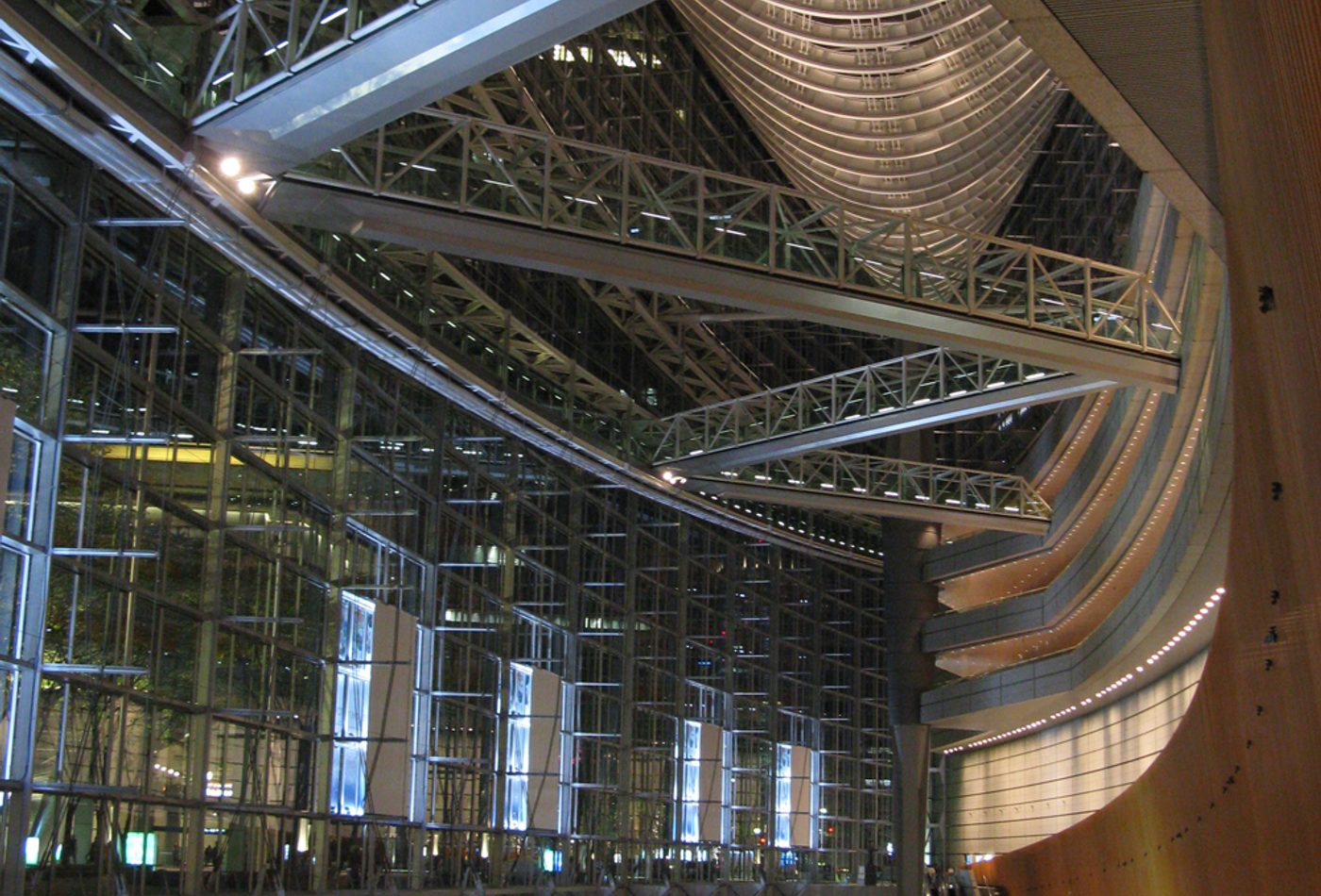
The building is often remembered for the boat-like Glass Hall. That comparison is useful if it points to structure and volume rather than decoration. The long atrium uses steel ribs, bridges, glass skin, and suspended circulation to make the interior feel like an engineered vessel. The form is not only a shape to recognize. It is a way to make movement, light, and structural rhythm visible to people walking through the complex.
The site sits between transit and culture
The project stands near Yurakucho and Tokyo Station, in a district where rail, offices, shopping, events, and everyday pedestrian movement overlap. That context matters because the building is not a remote conference center. It is embedded in one of Tokyo's busiest urban fabrics. The public value of the complex comes from letting visitors pass through, pause, look upward, cross bridges, enter halls, and keep moving through the city without the building feeling closed off.
Structure is the visible guide
The visible steel structure is a main reading tool. Trusses, ribs, bridges, and glass surfaces organize the enormous atrium and keep visitors oriented. Instead of hiding the building's technical system, the design makes it part of the public experience. This is why Tokyo International Forum belongs near high-tech and structural-expression architecture, even though it is calmer than Centre Pompidou. The structure is theatrical but also legible and useful.
The complex is more than the atrium
The Glass Hall is the famous part, but the project also includes multiple halls, meeting rooms, exhibition spaces, shops, circulation routes, plazas, and service systems. The architectural fact is how those pieces are coordinated around a large transparent interior. The building has to handle scheduled events and informal public movement at the same time. That dual role makes it different from a single-purpose auditorium or a purely commercial passage.
Transparency changes the civic mood
Glass is not only an envelope material here. It changes how public the building feels. The atrium lets daylight, city views, interior bridges, and structural depth remain visible at once. That transparency does not make the building simple; it makes its complexity readable. A visitor can understand that many routes and programs overlap because the building shows them rather than burying them behind opaque walls.
What to notice first
Start with the Glass Hall ribs, the suspended bridges, and the relationship to the surrounding rail-and-office district. Those details explain the building better than a generic cultural-center label. The ribs reveal structure; the bridges reveal movement; and the site reveals why a large public interior matters in Tokyo. Tokyo International Forum belongs in the core atlas because it teaches how structure, circulation, transparency, and urban density can become one civic experience.