guide
Taj Mahal Gate, Garden, and River Visit Notes
Start before the marble appears
The Taj Mahal is best read as a sequence, so do not begin only with the famous front photograph. Start with the gate and the first controlled view through it. That threshold teaches the main design idea: the mausoleum is revealed through framing, distance, and alignment. The building's power depends on delayed arrival. The first lesson is therefore not the dome, but the way the view is prepared.
Use the reflecting pool as a measuring line
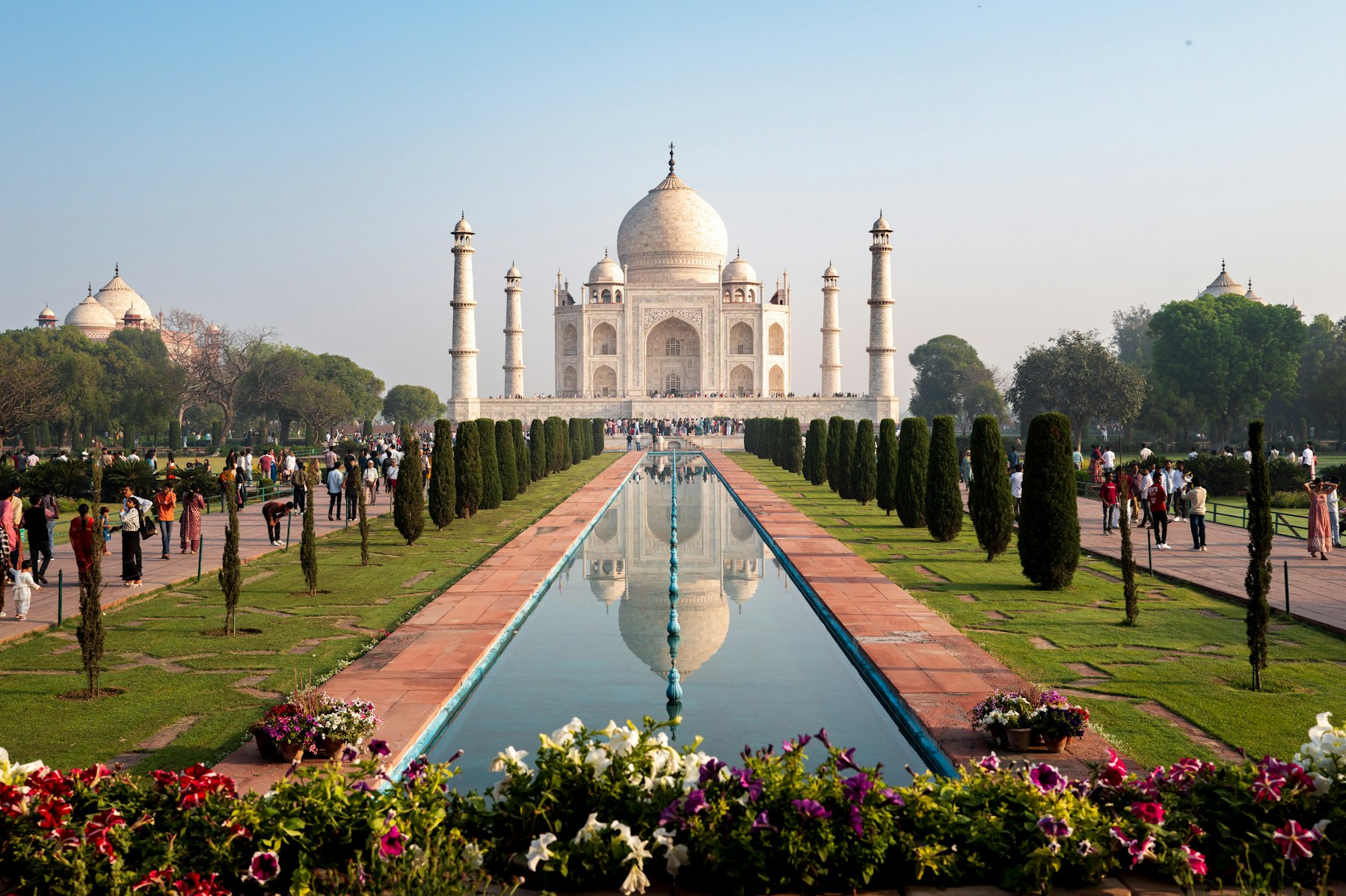
Once inside the garden axis, treat the reflecting pool as an architectural measuring line. It connects viewer, path, water, trees, platform, and tomb into one long composition. Stand far enough back to see the minarets, dome, and garden together before moving closer. The reflection is not only photogenic. It doubles the symmetry and makes the central axis legible even in a crowded view.
Compare marble with red sandstone
A quick visit can make the Taj Mahal seem like a single white object, but the complex depends on contrast. Look at the red sandstone gate, mosque, and jawab, then compare them with the white marble tomb. The color and material shift tells you where attention should concentrate. It also keeps the visitor aware that this is an ensemble with support buildings, not just one freestanding marble dome.
Move from silhouette to surface
At distance, study the dome, corner minarets, and platform as a complete silhouette. Up close, change the question. Look for inlaid stone, carved floral panels, calligraphy bands, marble joints, screens, and shadow around the large arches. The building rewards that shift because its design works at two scales: a perfect image from far away and a crafted surface at hand distance.
Do not ignore the side and rear relationships
Many visitors stay on the central garden line, but the side buildings and river edge change the reading. The mosque and jawab show how balance is maintained across the platform, while the Yamuna side reminds you that the tomb is placed in a larger landscape. If the central axis gives the postcard view, the side and rear angles explain how the monument sits in the wider precinct.
Three useful photo studies
Make three architectural images rather than one generic souvenir shot. First, take a long-axis image with pool, trees, platform, minarets, and dome in one frame. Second, take a material comparison image that includes marble against red sandstone or shadowed arch depth. Third, take a close detail of inlay, carving, calligraphy, or screen work. Those three studies preserve route, contrast, and craft.
What to compare after looking
After studying the Taj Mahal, compare it with the Alhambra for Islamic surface and garden relationships, with the Pantheon for a different kind of centralized sacred volume, and with Versailles for axial landscape power. The goal is not to rank monuments. It is to see how different cultures use symmetry, water, material, and approach to create authority and memory, then return to the Taj Mahal with sharper eyes and a more exact route.