guide
Taj Mahal History in Mughal Memory and World Heritage
The history starts with mourning and empire
The Taj Mahal's history is usually told through Shah Jahan's grief for Mumtaz Mahal, but the architecture is not only a private emotional gesture. It is also an imperial Mughal project that mobilized planning, craft, labor, materials, and courtly symbolism at a monumental scale. The building's historical force comes from that combination: personal memorial, dynastic image, religious meaning, and technical refinement were made visible in one carefully ordered complex.
Mughal architecture gives the vocabulary
The Taj Mahal belongs to a wider Mughal world of gardens, tombs, gateways, red sandstone, marble, water channels, domes, and axial planning. That context matters because the building did not appear from nowhere. It intensifies and refines patterns already present in imperial architecture. The result is not just a famous isolated monument. It is a peak example of how a court culture used geometry, craft, and landscape to express order.
The garden carries historical meaning
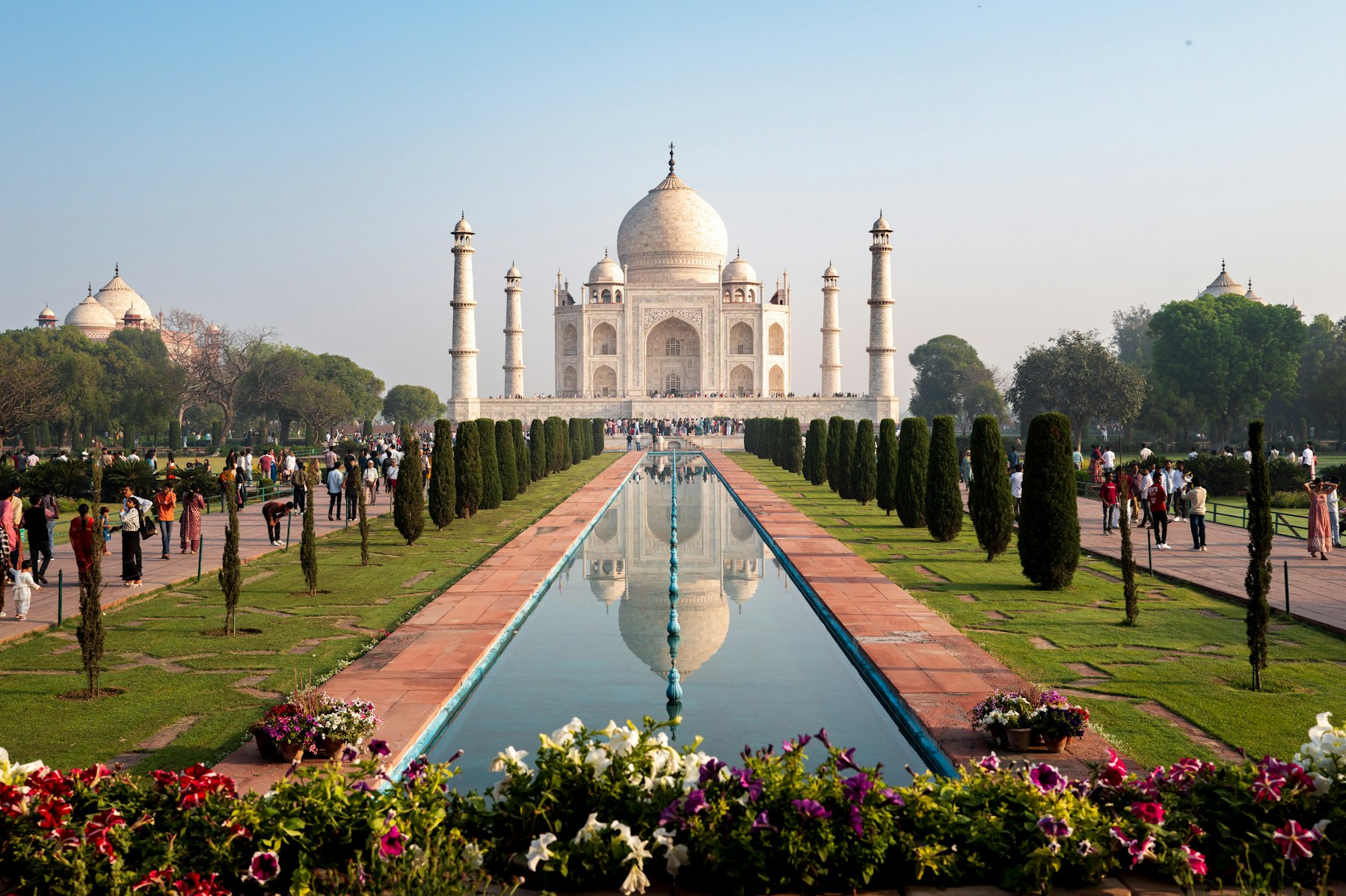
The charbagh garden is a historical idea as much as a plan. It connects the complex to paradise garden imagery and to traditions of ordered landscape in Islamic and Persianate culture. Water, shade, division into quadrants, and axial movement are therefore not simply aesthetic devices. They help explain why the tomb is approached as a journey through measured space. History is embedded in the visitor route.
Craft made power visible
The building's history also belongs to the people and workshops that made its surfaces. Marble carving, stone inlay, calligraphy, masonry, garden works, and structural execution all translate imperial ambition into material evidence. This is why a history page should not only name a patron and date. It should make room for craft systems. Without them, the Taj Mahal would remain a concept rather than a built object capable of surviving close inspection.
Why the image traveled so widely
The Taj Mahal became globally recognizable because its image is both simple and dense. A central dome, four minarets, a long water axis, and a pale marble surface can be understood quickly in reproduction. At the same time, the building carries a memorable story of love, power, loss, and paradise imagery. That combination lets the monument circulate as postcard, textbook case, travel destination, and architectural reference.
UNESCO recognition and preservation pressure
UNESCO listing in 1983 confirmed the monument's global heritage status, but recognition also makes preservation pressure more visible. Pollution, visitor numbers, river context, surface conservation, and management of the wider precinct all shape how the building is maintained. The Taj Mahal is therefore not only a seventeenth-century achievement. It is a continuing conservation responsibility whose image depends on ongoing care.
The historical lesson
The useful historical lesson is that architecture can turn memory into a public spatial system. The Taj Mahal does this through a tomb, garden, gateway, mosque, water axis, marble surface, and repeated symmetry. It is famous because the system is clear enough for a first-time visitor and rich enough for deeper study. That is why it belongs in the core atlas rather than only in a list of world wonders.