guide
Taj Mahal Design: Symmetry, Marble, and Water
Symmetry is the method, not the whole design
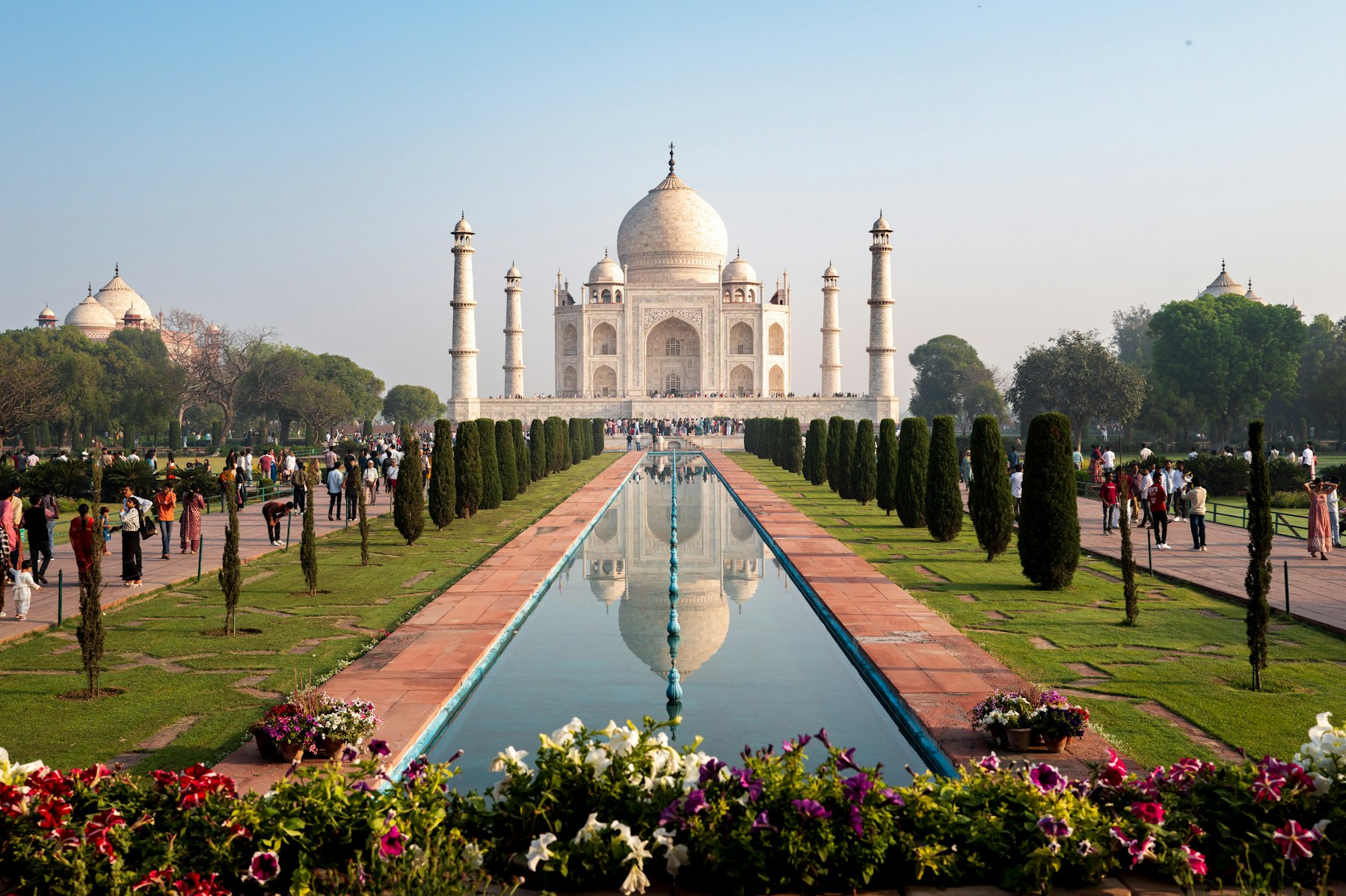
The Taj Mahal is symmetrical, but stopping there makes the design sound simpler than it is. Symmetry organizes the visitor's eye, slows the approach, and makes small departures matter. The central dome, corner minarets, platform, garden paths, reflecting pool, mosque, and jawab all participate in a controlled order. The design's power comes from how that order is experienced over distance, not from a flat front elevation alone.
The garden turns movement into architecture
The garden is not only foreground. It is one of the main architectural instruments. The long pool, cypress lines, paving, and planted quadrants make the visitor approach the tomb through measured intervals. That sequence gives the marble building time to grow in scale. It also connects the complex to paradise garden traditions, where water, geometry, shade, and procession are part of the spatial meaning rather than decorative landscape afterthoughts.
The main dome depends on its companions
The bulbous central dome is the most recognizable form, but it works because it is supported visually by smaller domed kiosks, the high pishtaq arches, corner minarets, and the platform. Those companion elements prevent the dome from floating as a single object. They create a hierarchy: broad platform, vertical framing, central arch, dome, finial. Reading that hierarchy is more useful than saying the dome is merely beautiful.
Material contrast carries the design
White marble, red sandstone, inlaid stone, and garden water all have separate roles. Marble concentrates attention on the tomb and changes with light. Red sandstone gives weight and contrast to the mosque, jawab, and gateways. Stone inlay rewards close looking after the distant view has done its work. Water doubles the axis and makes the tomb seem suspended between earth, reflection, and sky.
Decoration is structural to the experience
The floral inlay, carved panels, calligraphy bands, and surface pattern should not be treated as decoration added to an otherwise complete form. They control scale. From far away, the Taj Mahal is a perfect silhouette; up close, the surface breaks into hand-scale evidence of craft. The shift from image to detail is what makes the building work as both imperial composition and intimate memorial surface.
The river edge changes the plan
The Yamuna River setting means the tomb is not centered in the garden in the simple way many visitors expect. The marble mausoleum sits toward the river edge, giving the garden approach a long foreground and giving the rear of the complex a different relationship to water and horizon. That placement makes the familiar frontal image only one part of the plan. The building has a river-facing life as well as a garden-facing life.
The design mistake to avoid
The common mistake is to reduce the Taj Mahal to romance and symmetry. A stronger design reading asks how geometry, craft, water, platform, dome, minarets, side buildings, and river setting cooperate. The building is disciplined, but it is not static. It changes through approach, light, reflection, close detail, and the difference between the marble tomb and the red sandstone ensemble around it.