guide
St Peter's Basilica History Across Renaissance Rome
The history is an argument over authority
St Peter's Basilica is not only an architectural history of style. It is an argument over religious authority, memory, patronage, and public image. Replacing the older basilica meant intervening in a site associated with apostolic memory while also making a new Rome visible. That tension explains why the project mattered so intensely. A historical reading should therefore ask what each phase tried to prove: continuity with sacred tradition, renewed papal power, technical ambition, urban control, or ceremonial clarity.
Julius II made rebuilding unavoidable
The 1506 foundation under Julius II turned renewal into action. The decision was bold because a replacement basilica had to address both architecture and legitimacy. The project could not simply produce a better building; it had to justify itself against memory, ritual, cost, and scale. This is why the earliest phase matters beyond a date. It set up the central historical problem: how to build something new at a site where continuity was part of the building's claim to importance.
Changing architects changed the building
The long list of architects is not trivia. It is the reason St Peter's carries several historical layers in one fabric. Bramante's early ambition, Raphael's revisions, Sangallo's proposals, Michelangelo's powerful simplification, della Porta and Fontana's dome completion, Maderno's nave and facade, and Bernini's square all changed how the project could be understood. The building became a record of changing priorities: centralization, procession, facade image, urban gathering, and papal theater.
Michelangelo gave the dome historical force
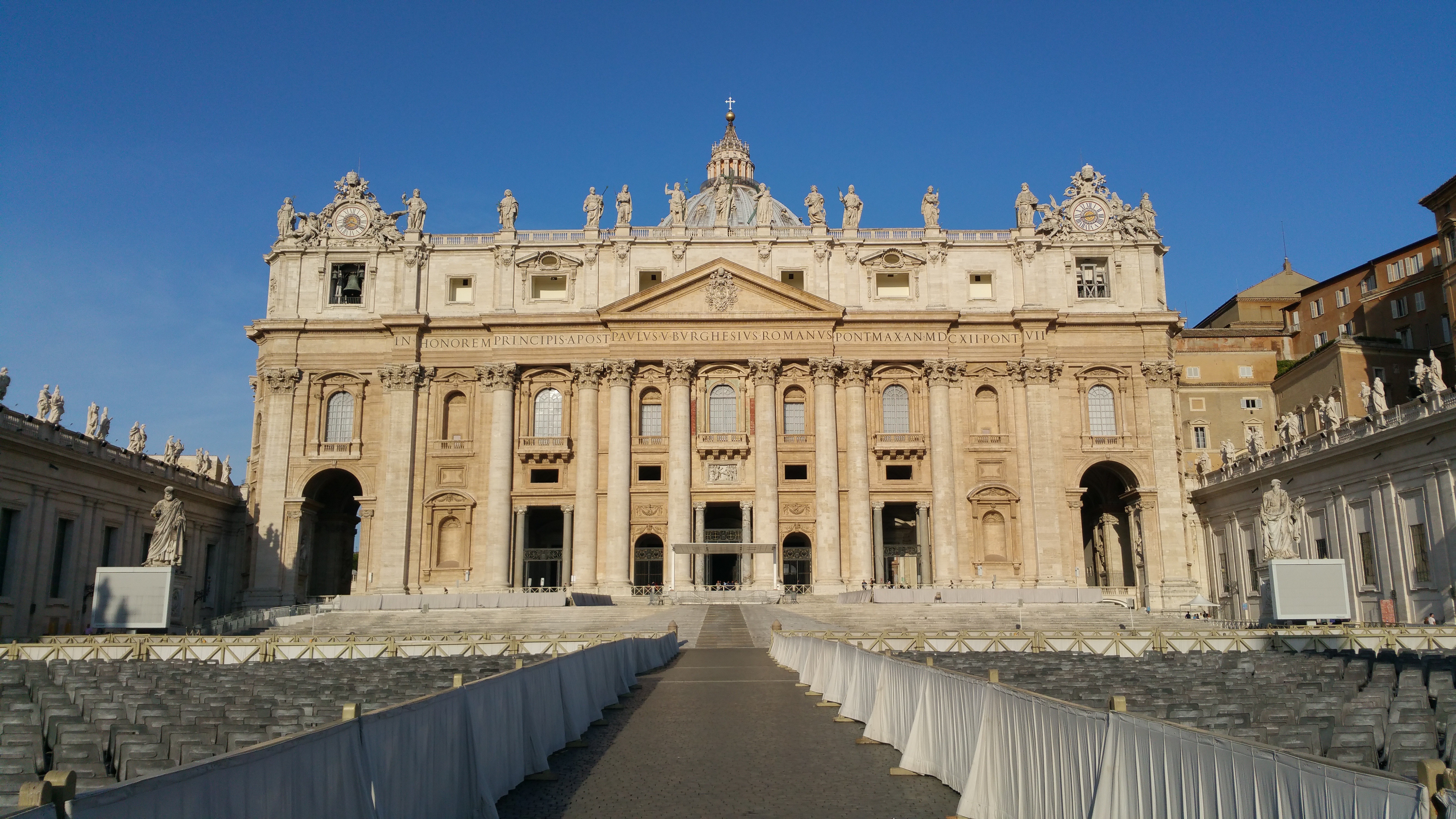
Michelangelo's role matters because the dome became the building's most durable public image. He did not finish the entire basilica, but his work at the crossing and dome gave later phases a powerful vertical center to answer. The dome's completion after him by Giacomo della Porta and Domenico Fontana also matters historically because it shows continuity after authorship. The public image is associated with Michelangelo, but the actual construction history depends on collective continuation.
Maderno shifted the church toward procession
Carlo Maderno's work changed the balance of the basilica. By extending the nave and completing the facade, he made the building more strongly processional and more directly tied to the square-facing public front. This shift is one source of the building's historical complexity. Some readings prefer the clarity of a centralized Renaissance ideal; the built basilica gives visitors a long ceremonial route. Maderno's phase therefore turned a design debate into an experience that every visitor still walks.
Bernini made public space part of the story
Bernini's square gave the basilica a Baroque urban ending, or more accurately a Baroque beginning for the visitor. The colonnades transformed the approach into a public event and helped the church operate at the scale of papal ceremony. This historical phase matters because it moved the project beyond the building envelope. St Peter's became a church, a piazza, a gathering device, and a public image for Catholic Rome at the same time.
Historical reading check
A useful history page should make St Peter's harder rather than smoother. The basilica is not the work of one genius, one style, or one construction campaign. It is a long sequence of sacred memory, Renaissance plan debate, dome engineering, facade politics, Baroque urban theater, and ongoing pilgrimage use. Once those layers are visible, the building's importance comes from the fact that different architectural answers remain present in the same public route.