guide
St Peter's Basilica Facts: Dome, Nave, and Piazza
The 1506 date starts a replacement story
The useful first fact about St Peter's Basilica is that the new basilica began as a replacement, not as a building on an empty site. The foundation stone was laid under Pope Julius II in 1506, and that date should be read as the beginning of a long architectural argument over how the most important papal church in Rome should look, move, and signify. A basic facts page should not flatten the basilica into one author or one year. Its identity comes from a century of decisions made by patrons, architects, builders, and artists working over an earlier sacred memory.
Many architects shaped one building
St Peter's is often remembered through Michelangelo's dome or Bernini's piazza, but the building cannot be understood through one name. Bramante, Raphael, Antonio da Sangallo the Younger, Michelangelo, Giacomo della Porta, Domenico Fontana, Carlo Maderno, and Bernini all belong to the public story. That list matters because the visible basilica is a composite. The dome, nave, facade, chapels, crossing, and square answer different architectural moments. Instead of asking for a single author, the reader should ask which part of the sequence each author helped make legible.
The dome is the vertical anchor
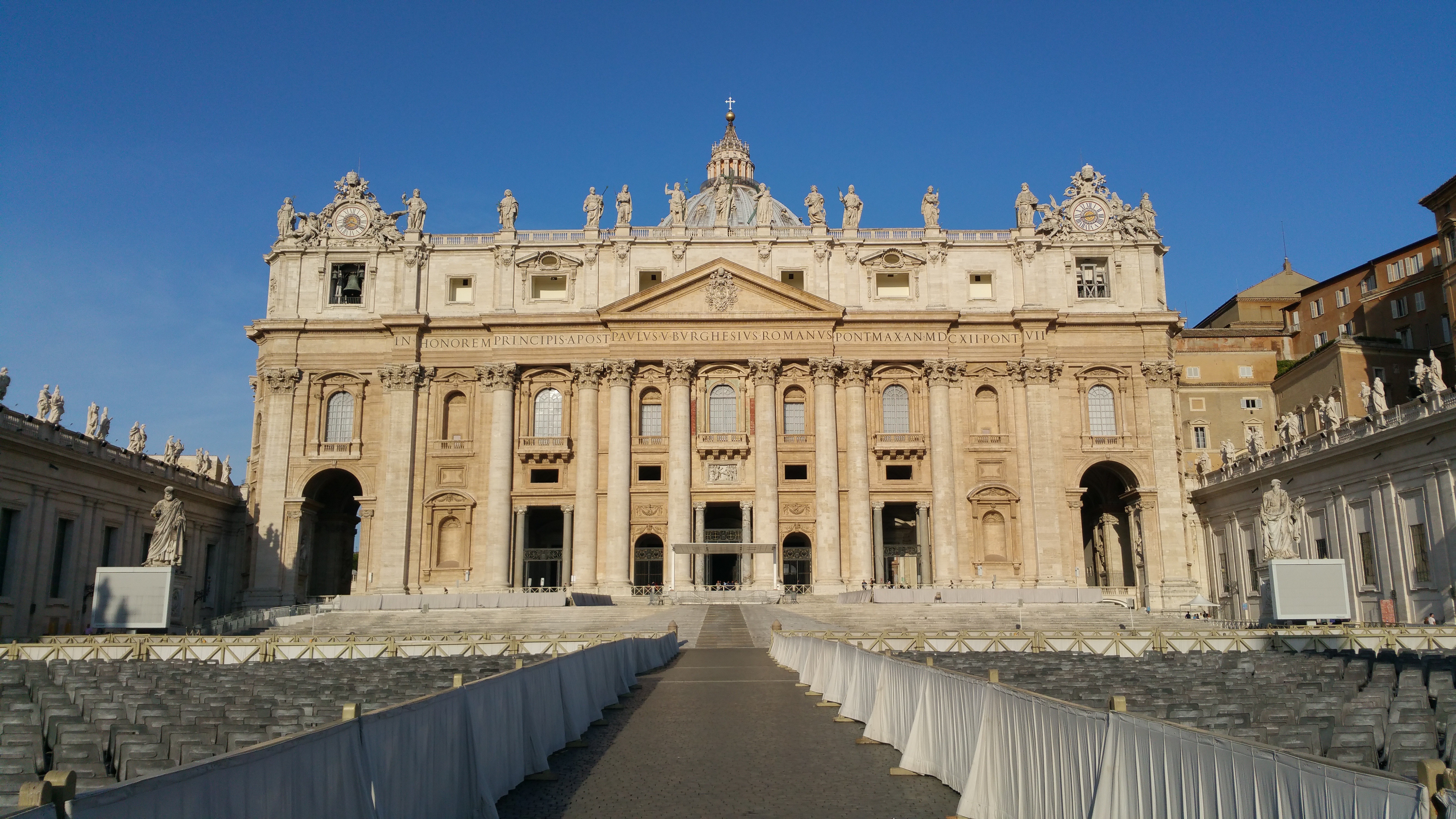
The dome is the fact that organizes distant recognition. It rises above the basilica and keeps the crossing visible in the skyline, even though the long nave and broad facade can hide the dome from some close frontal views. This tension is important. From far away, the dome promises a centralized sacred space. From the square, the facade and nave delay that dome. St Peter's therefore teaches a basic architectural lesson: the public image and the walking experience are not identical, and the building gains force from managing the gap between them.
Maderno's facade changes the first reading
The facade completed under Carlo Maderno is the visitor's first architectural wall. It is wide, ordered, ceremonial, and more horizontal than the dome image might lead a reader to expect. This matters because the facade does not simply decorate the basilica. It controls arrival, frames the balcony and entrances, and turns the church into a public papal front. A viewer who studies only the dome misses the way the facade absorbs the crowd before the interior releases that crowd into a much larger spatial sequence.
Bernini's square is part of the basilica
Saint Peter's Square should be treated as part of the building's architecture, not as a separate plaza in front of it. Bernini's colonnades make the approach theatrical, directional, and collective. They gather the visitor before the facade and create a transition from the city to the church. The obelisk and open oval help the space stay readable at crowd scale. This is why the most important exterior fact is not only the facade elevation, but the relationship between square, colonnade, axis, and church front.
Scale is the main fact inside
Inside, the basilica works through scale. The nave, piers, chapels, crossing, dome, altar, and side spaces are all large enough to make ordinary measurement feel unreliable. That scale is not only numerical. It changes how details are read. Marble surfaces, bronze work, sculpture, inscriptions, light, and pavement pattern all operate inside a space that repeatedly expands beyond the body. A good fact page therefore has to connect dimensions to experience: the basilica is famous because scale becomes a ritual instrument, not because it is merely big.
What the facts should help you see
Use the facts as a viewing order. The 1506 foundation explains replacement and ambition. The architect list explains why the building has several design voices. Michelangelo's dome explains the crossing and skyline. Maderno's facade explains arrival and papal image. Bernini's square explains public gathering. The long nave explains procession. Together those facts make St Peter's less generic. It is not only a large church, but a sequence where Renaissance geometry, Baroque theater, papal ceremony, and pilgrimage movement meet.