guide
St Paul's Cathedral Dome and City Visit Notes
Start with a long view of the dome
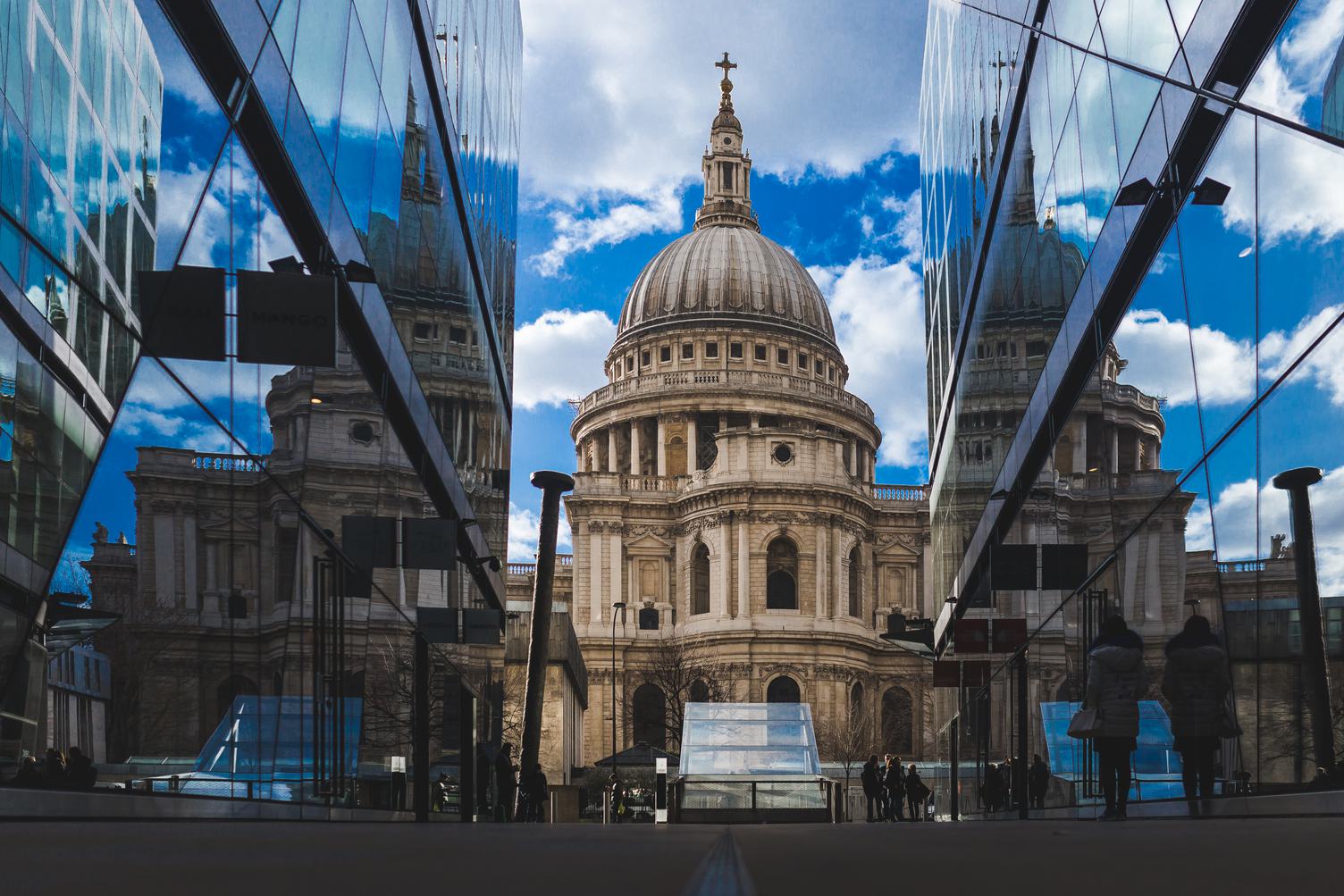
Begin by finding a view where the dome appears as part of London rather than as an isolated object. A river approach, a bridge view, or a street opening can show why St Paul's became a city marker. The important thing is to keep surrounding buildings in the frame. The dome's power depends on contrast: curved stone profile against roofs, offices, sky, and movement. A close-up alone cannot explain that urban role.
Approach the west front slowly
Use the west front as the main arrival study. Look at the towers, steps, columns, doorways, and width before thinking about the dome again. This front turns the cathedral from skyline image into public entrance. It also sets up the direction of the nave. If the visit begins only with the dome, the building can feel like one famous shape. The west front restores sequence, scale, and ceremony.
Read the nave as a route
Inside, treat the nave as a route rather than a hall to cross quickly. Notice how the long axis organizes the body, how repeated structural bays control rhythm, and how the eye is drawn toward the crossing. The dome should feel prepared by that movement. This makes the visit more architectural because it links plan, procession, and vertical climax. The central space is stronger when the route to it has been noticed.
Look for the dome's two lives
The dome has one life outside and another inside. Outside, it is a skyline profile. Inside, it is part of a spatial sequence, light condition, and structural drama. Try to compare those two readings during the same visit. Ask whether the exterior dome feels heavier, calmer, or more distant than the interior experience below it. That comparison is the best way to avoid treating the dome as a simple symbol.
Study Portland stone at hand scale
At close range, give time to the stone. Look for joints, steps, carved detail, weathering, shadow under moldings, and the way pale surfaces change under grey or bright light. These details connect the massive public image to human scale. St Paul's is not only a large composition. It is also a stone building made from repeated edges, surfaces, and transitions that can be read from arm's length.
Use the churchyard and nearby streets
Do not limit the visit to the interior. The churchyard and surrounding streets show how the cathedral sits in the City. Step back, move around corners, and watch where the dome disappears and returns. These small changes explain the building's urban intelligence. St Paul's often works through partial views: a tower edge, a dome shoulder, a stone wall, or a sudden full composition at the end of a street.
Make a five-part visual record
A useful architecture visit should leave five kinds of evidence: one long skyline or bridge view, one west-front arrival view, one nave-axis view, one dome or crossing view, and one close stone detail. Those five views preserve the building's main questions: city image, entrance, procession, vertical structure, and material scale. They also prevent the visit from collapsing into one centered photograph of the dome.