guide
St Paul's Cathedral History After the Great Fire
The Great Fire made the commission public
St Paul's Cathedral cannot be understood without the Great Fire of 1666. The fire did not merely damage a church; it destroyed the old cathedral at the symbolic center of the City. Rebuilding therefore carried a public burden. The new St Paul's had to restore religious function, but it also had to show that London could rebuild itself with order, ambition, and a changed architectural language. That is why the building's history begins with urban recovery rather than with style labels.
Wren's role joined architecture and city repair
Christopher Wren's authorship matters because the cathedral was part of a larger post-fire rebuilding culture. He was not only designing a picturesque dome. He was working within questions of church reform, urban repair, public ceremony, engineering, and long institutional patience. The length of the project made the design a generational civic act. St Paul's therefore records the difficulty of rebuilding a city through architecture that had to satisfy worship, politics, craft, finance, and public memory.
Completion did not freeze the meaning
Although the cathedral was completed in 1710, its meaning kept changing. A building of this scale becomes historical through repeated public use: services, state occasions, funerals, memorial events, tourism, conservation, and daily orientation in the City. The dome became more than an architectural feature because people kept using it as a public image. In that sense, completion is only one historical date. The longer story is how the cathedral became a shared London reference.
The dome became a resilience image
St Paul's is often associated with resilience because its dome came to stand for the survival of London during later crises, especially wartime memory. That association can become sentimental if it is separated from the architecture. The stronger reading connects memory to form. A clear dome above the City, a durable stone mass, and a long rebuilding origin all make the cathedral available as a symbol of endurance. The building's history works because its architecture gives public memory something visible to hold.
Listing status confirms public importance
Historic England's Grade I listing is not the reason St Paul's matters, but it records the level of public and architectural importance attached to the building. The list description fixes key coordinates: Wren, late seventeenth- and early eighteenth-century construction, Portland stone, central dome, and western towers. Those details align with what a visitor can actually see. The listing helps keep the history attached to material evidence rather than allowing the cathedral to drift into vague national symbolism.
The skyline around it has kept changing
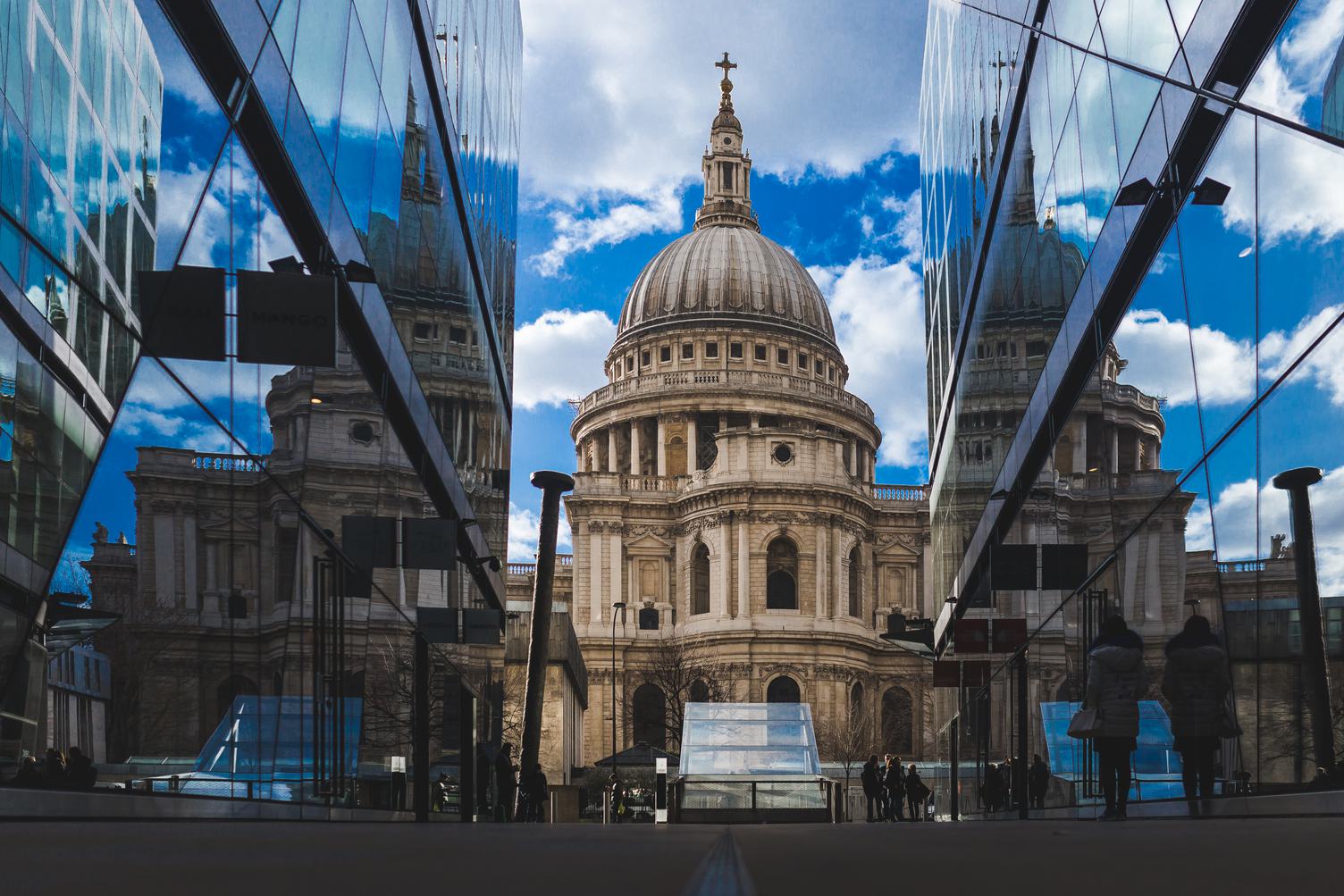
The historical reading of St Paul's changes as London changes around it. New commercial towers, protected views, river crossings, office districts, and tourist routes all alter the way the dome is framed. This does not weaken the cathedral's history. It makes the building a measuring device for the city. Each newer skyline view asks how a post-fire Baroque monument can remain legible inside a much denser and more vertical financial district.
Historical reading check
A useful history page should make St Paul's feel less automatic. The key shift is from famous dome to public rebuilding instrument. The cathedral joins fire, Wren's design labor, Portland stone, dome engineering, worship, state memory, conservation, and changing skyline pressure. Once those layers are visible, the building is no longer just a London icon. It becomes evidence of how architecture carries a city through repeated acts of recovery and reinterpretation.