guide
St Paul's Cathedral Facts: Dome, Wren, and Portland Stone
The date belongs to a rebuilding story
The useful first fact about St Paul's Cathedral is not simply the completion year of 1710. The cathedral belongs to the rebuilding of London after the Great Fire of 1666, when the previous medieval cathedral was lost and a new public church had to carry civic as well as religious meaning. Christopher Wren's commission therefore produced more than a replacement building. It gave the City of London a new architectural center after disaster, one that could be recognized from streets, river views, and later skyline comparisons.
Wren made the dome the public signal
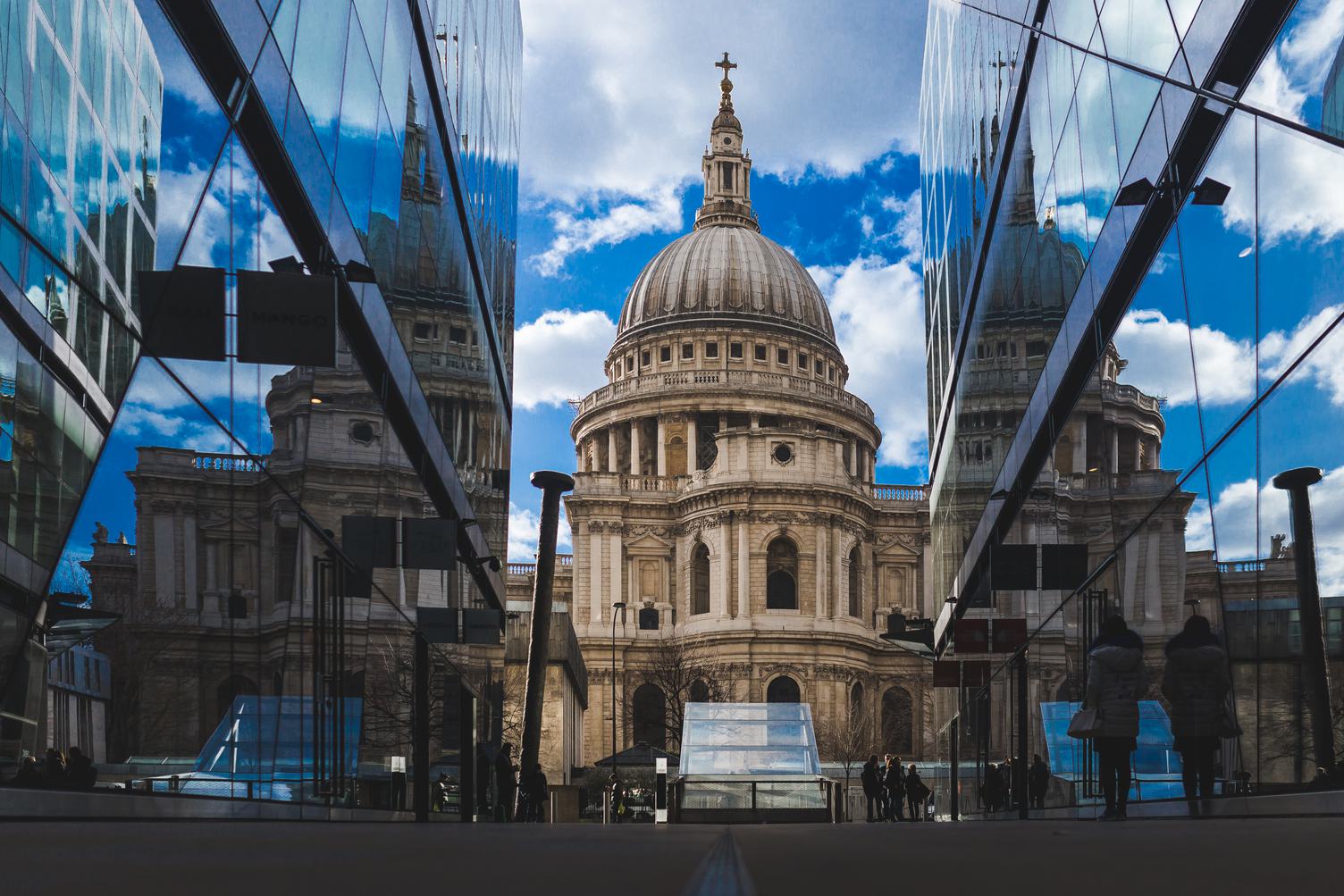
St Paul's is remembered through its dome because the dome solves several roles at once. It crowns the crossing, marks the cathedral from a distance, and gives London a vertical image that is different from a Gothic spire. The dome is not only a smooth silhouette. It is a layered structural and visual problem, with an inner reading for worship, an outer profile for the city, and hidden engineering between them. That layered dome is the fact that makes St Paul's different from a simple masonry church with a large roof.
Portland stone gives the cathedral its weight
The cathedral's Portland stone matters because it turns scale into surface. From far away, the stone helps the dome, west towers, and long nave read as one pale mass against the London sky. From close range, the same material records joints, shadow, carving, steps, columns, and weathering. A reader should not treat material as a decorative note. At St Paul's, stone is part of the public image: it makes the building feel durable, civic, and materially continuous across a large and complex plan.
The west front is a second landmark
The dome often dominates the memory of St Paul's, but the west front and its towers are just as important to the first architectural reading. The west end organizes arrival, sets up the axial route into the nave, and gives the cathedral a ceremonial face toward the city. The twin towers prevent the building from being reduced to one central dome. They make the cathedral work as a sequence: approach the front, enter the nave, move toward the crossing, and then understand why the dome controls the whole composition.
The plan is easier to read than the skyline
A skyline view explains why St Paul's became famous, but the plan explains how it works. The long nave, crossing, choir, aisles, and west front give the cathedral a strong directional order. That order keeps the building from becoming only a domed object. The visitor moves through a processional axis before reaching the space beneath the dome. The building's public image is therefore supported by a slower interior logic: direction first, central space second, city silhouette always in the background.
The facts should change what you look for
Use the basic facts as a viewing method. The Great Fire explains why replacement and memory matter. Wren explains why the cathedral speaks a Baroque language in London. Portland stone explains its civic weight. The dome explains its city image. The west front explains arrival. The nave axis explains movement. Those facts are useful only if they make the building less generic: St Paul's is not simply a famous cathedral, but a post-fire urban monument where structure, ceremony, material, and skyline are tied together.
Public reading check
A reader should leave this facts page able to connect five parts without leaning on vague landmark praise: the Great Fire, Wren's rebuilding role, Portland stone, the triple-shell dome, and the cathedral's place in the City of London. If those parts stay connected, the building becomes easier to read in person and in photographs.