guide
Parthenon Design: Proportion, Refinement, and Hilltop Presence
The design works through restraint
The Parthenon's design is powerful because it does not depend on a complex outline. The main form is a rectangular temple raised on the Acropolis, surrounded by a disciplined colonnade. Its intelligence lies in how much architectural meaning is carried by proportion, rhythm, correction, and setting. A quick glance sees a classical ruin; a slower reading sees a system of repeated columns, compressed corners, measured horizontals, and small refinements that prevent the form from feeling merely mechanical.
The colonnade controls the whole reading
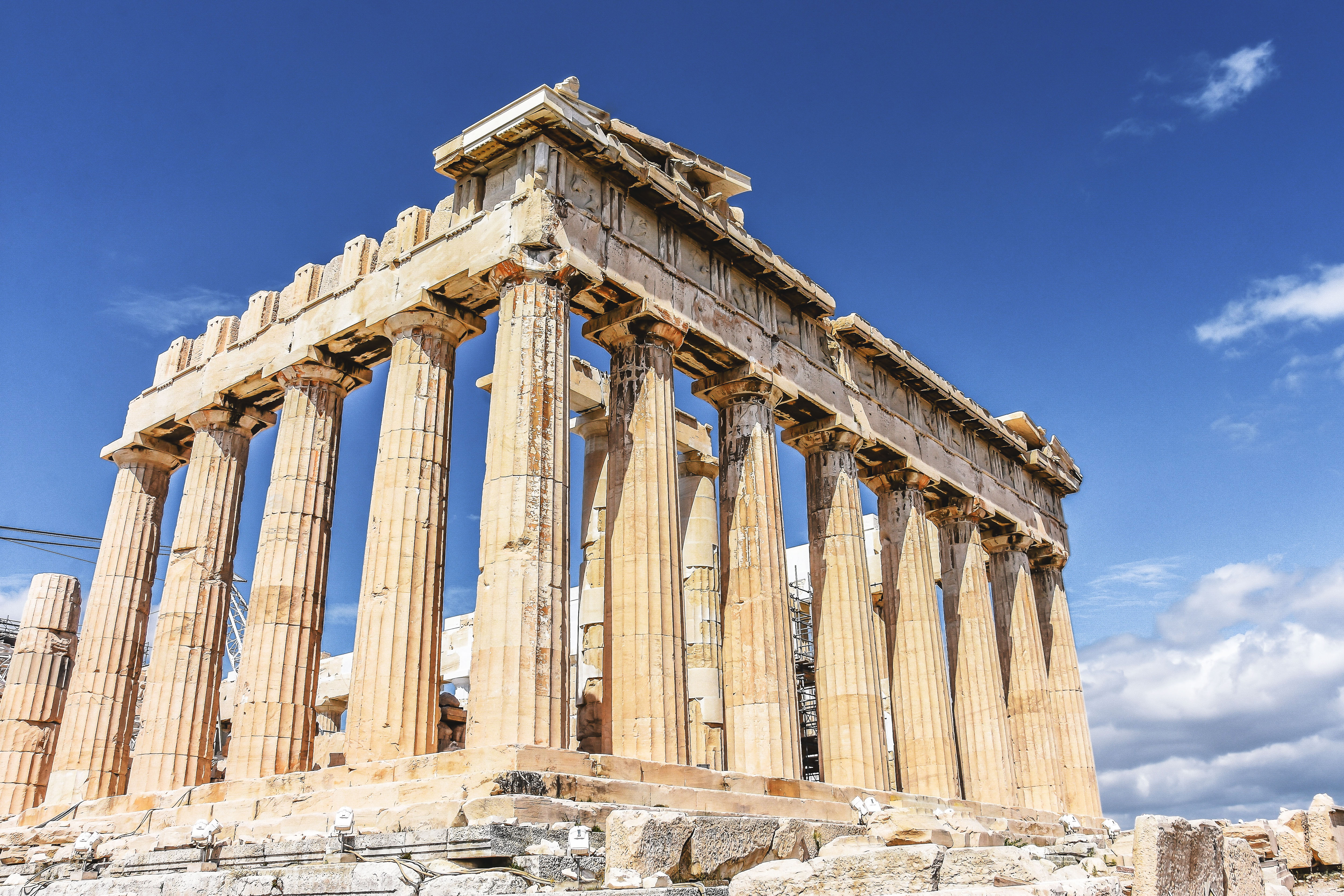
The Doric columns are not only supports. They create the building's public rhythm and decide how the body is read from every side. Fluting catches light, column spacing sets pace, and the corner condition concentrates attention where two elevations meet. Because the building is approached from changing angles on a rocky site, the colonnade has to work as perimeter, screen, shadow device, and symbol at once. That makes the exterior sequence more important than a single front elevation.
Optical refinements make stone feel responsive
The Parthenon is often admired for refinements such as slight curvature and carefully adjusted column behavior. These moves matter because they show architecture responding to perception. Long stone lines can seem to sag or deaden when treated as pure geometry. The refinements make the temple feel taut, balanced, and alive under the eye. They are not decorative flourishes. They are design decisions that bridge measured construction and human vision.
Corners carry unusual pressure
The corners are especially useful for design analysis because they compress several systems into one place. Column spacing, triglyph rhythm, entablature weight, side elevation, front elevation, and viewer angle all meet there. A weak corner would make the building feel like two flat facades pasted together. The Parthenon's corner condition helps the temple read as a complete stone volume, not only as a front with two long sides attached.
Mass and void are held in balance
A temple can easily read as either heavy stone mass or open colonnade. The Parthenon holds those conditions together. The columns create gaps, shadow, and layered depth; the entablature and cella hold the building as a solid body. This balance lets the temple feel both accessible to the eye and ceremonially contained. The ruin condition now exposes more void than the original experience would have, but the underlying design still depends on the tension between enclosure and perimeter rhythm.
Material detail keeps the order human
Pentelic marble gives the Parthenon a fine scale at close range. Chips, joints, fluting, weathered edges, repaired blocks, and surviving fragments stop the building from being only an abstract diagram of classical proportion. The material surface records craft, damage, restoration, and time. This is especially important for a famous monument: the most reproduced image is a distant outline, but the most architectural evidence often sits in the small stone transitions. The existing condition asks the viewer to read design through survival, not through an imagined perfect reconstruction alone.
The Acropolis makes the temple urban
The Parthenon is not a freestanding object on neutral ground. The Acropolis changes the design reading by adding ascent, exposed rock, city views, neighboring monuments, and long-distance recognition. The building participates in a larger sacred and civic landscape. Its form must therefore be read in two scales at once: as a refined temple body and as a marker above Athens. That dual scale is one reason the ruin remains legible even when many original elements are missing.
The design lesson
The Parthenon's design lesson is that classical architecture is not only a vocabulary of columns and pediments. It is a discipline of perception. Proportion, curvature, column rhythm, material surface, sculpture zones, and site placement are made to support one another. A shallow reading sees a famous old temple. A stronger reading asks how the building turns severe order into a vivid visual experience that still survives through fragment, repair, and distance.