guide
Pantheon Rome History from Temple to Church
The history is written across layers
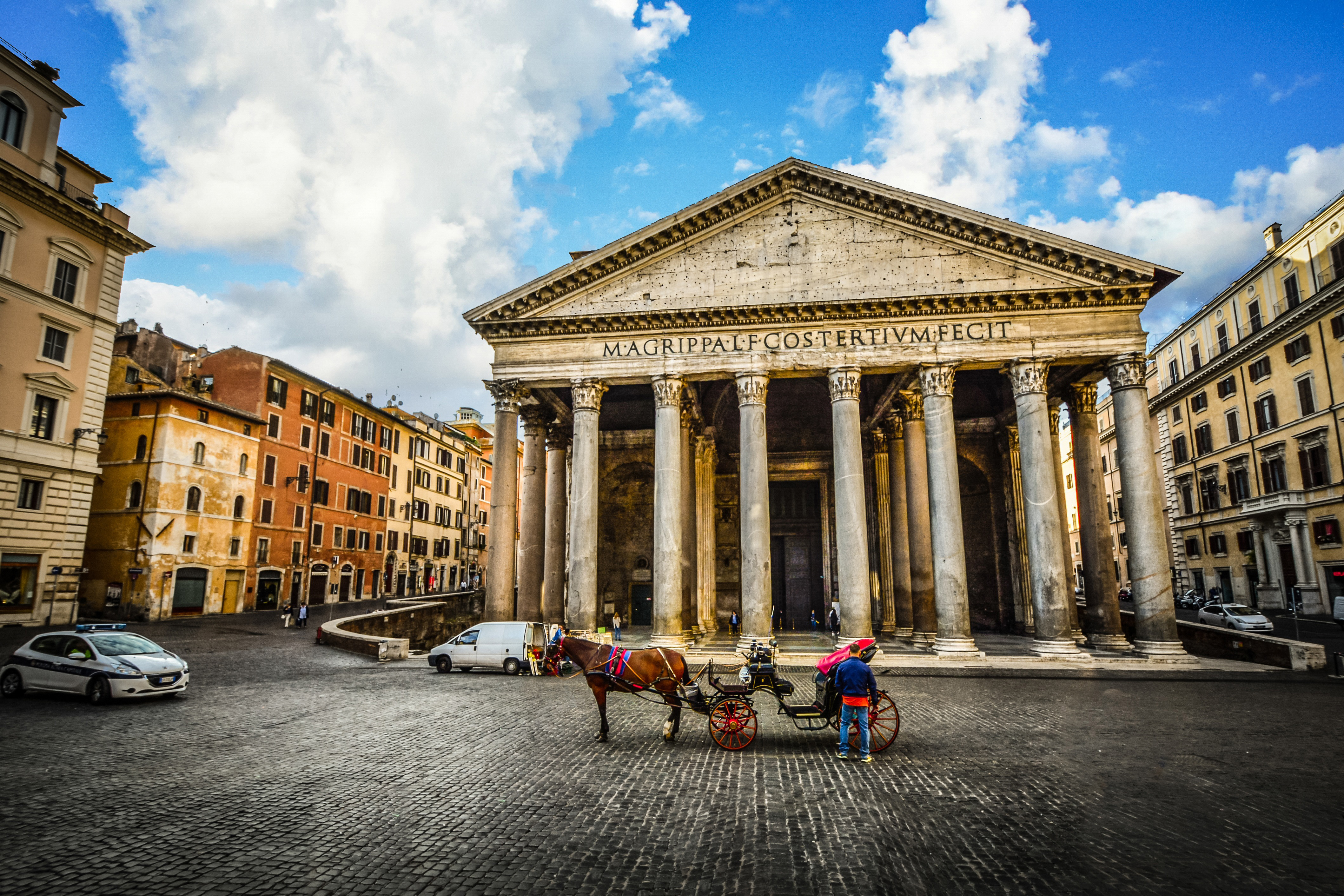
Pantheon Rome is not useful as a simple before-and-after story. Its history is layered into the building itself: an inscription recalling Agrippa, a later Roman structure with a radical concrete dome, Christian reuse, changing materials, burials, tourism, and ongoing care. This layered condition is exactly why the building matters. It lets readers see how architecture can carry political memory, technical ambition, and later religious life in one body.
Imperial Rome used architecture as memory
The Pantheon belongs to a Roman world where building, rebuilding, inscription, and public display were tied to authority. The front inscription gives the building an inherited name and historical dignity, even though the existing structure reflects later construction. That tension should not be treated as confusion. It is part of the monument's historical meaning: Rome often preserved memory while transforming fabric, and the Pantheon makes that process visible.
Engineering became cultural evidence
The concrete dome is historical evidence as much as technical achievement. It shows that Roman builders could create a vast centralized interior that did not depend on a forest of columns. The dome, coffers, thick walls, and oculus made engineering into an experience that later visitors could understand physically. This is why the Pantheon stayed influential: it did not only record a construction method; it made that method emotionally legible.
Reuse helped it survive
Many ancient buildings survive as fragments because their original use disappeared and their materials became available for other projects. The Pantheon followed a different path. Its conversion into a church gave the building an active institutional role, which helped protect the main structure. That does not freeze the building in its Roman state. It means survival came through adaptation, and adaptation became part of the historical record.
Later architects learned from it
The Pantheon shaped later architecture because it offers a clear model: a strong exterior threshold, a centralized interior, a dome with a single opening, and a room where geometry and light carry meaning. Renaissance and later architects did not need to copy every detail to learn from it. They could study the relationship between plan, section, structure, and atmosphere. Its influence comes from the clarity of the architectural idea.
The urban setting kept changing
The building's historical life cannot be separated from Rome around it. Streets, piazza space, surrounding buildings, changing ground levels, worship, visitors, conservation, and city traffic all shape how the monument is encountered. The Pantheon is famous as an ancient interior, but it also operates as an urban object in a living district. That continuing contact with the city is one reason it feels unusually present rather than remote.
The historical lesson
The Pantheon teaches that longevity is not only a matter of durability. It depends on usefulness, reinterpretation, symbolic value, and the ability of a form to absorb new meanings without losing its core spatial force. The building has been temple memory, church, model, tourist destination, and engineering lesson. That range is why it deserves a full guide rather than a short caption about an ancient dome.