guide
Pantheon Rome Design: Rotunda, Portico, and Oculus
The design begins with a controlled contradiction
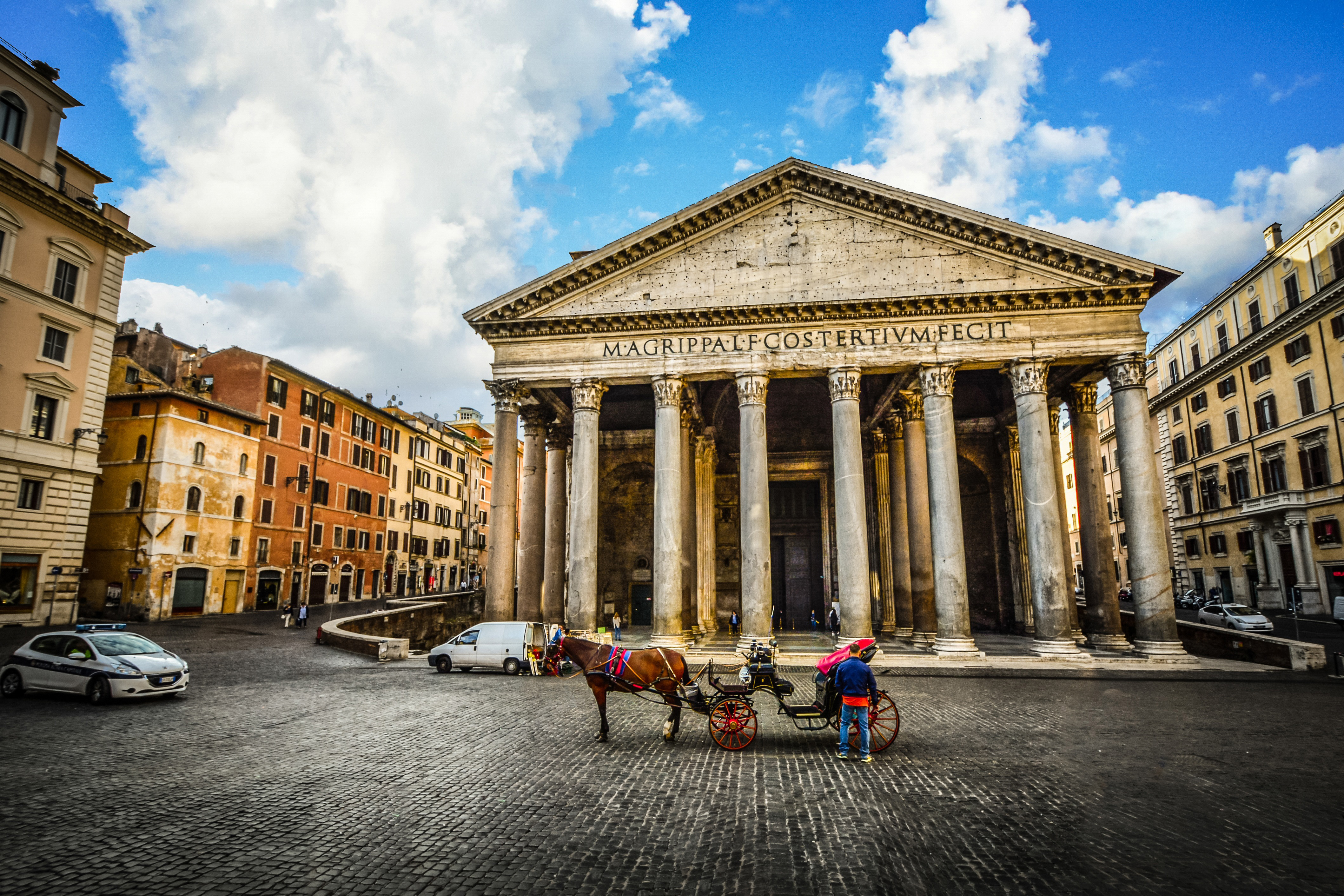
Pantheon Rome works because the front and interior do not say the same thing. The portico belongs to the language of columns, pediment, axial entry, and civic address. The rotunda belongs to enclosure, circular geometry, and a dome that gathers the room into one centered volume. The design does not hide this contradiction. It stages it, asking the visitor to pass from a classical front into a space that feels almost cosmic.
The portico is more than a facade
The porch gives the building a public face in the piazza, but it also slows entry. Columns create depth, shade, and a moment of compression before the interior opens. That pause matters. Without the portico, the rotunda would still be technically impressive, but the visitor would lose the transition from city to threshold to interior. The portico makes the building urban before the dome makes it spatially absolute.
The rotunda turns wall into horizon
Inside, the curved wall does not behave like a normal facade. It wraps the visitor, holds niches and surfaces, and supports the dome without presenting a single front. This makes the room feel centered rather than directional. The visitor can turn in place and keep reading architecture in every direction. The rotunda is therefore not just a plan shape. It is a way of removing ordinary front-and-back hierarchy from the interior.
Oculus light makes time visible
The oculus is the design's most memorable detail because it is both opening and instrument. It brings daylight into the room, makes the dome feel open at its highest point, and lets weather and time register inside the architecture. The beam of light is not decoration placed on a surface. It is produced by the building's geometry. That is why the Pantheon is understood differently across a day rather than only from a fixed viewpoint.
Coffers discipline the dome
The dome could have felt like an overwhelming mass, but the coffers give it order. They create rings of scale, guide the eye upward, and make the surface feel designed rather than simply heavy. The relationship between the coffers and the oculus is especially important: repeated pattern gives way to a single void. The design moves from measured surface to pure opening, which makes the top of the room feel both structural and symbolic.
Material memory is built into the experience
The Pantheon is read through concrete, stone, brick, marble, bronze memory, repair, and the traces of long use. Its surfaces do not all belong to one untouched moment. That layered material condition is part of the design experience now. A clean reconstruction would teach one thing; the existing building teaches another. It shows Roman engineering, later adaptation, removed materials, renewed surfaces, and continuing care in one interior.
The design lesson
The Pantheon's design lesson is not simply that Roman concrete was advanced. The sharper lesson is that structure, geometry, light, and sequence can become inseparable. The portico prepares the visitor, the rotunda gathers the body, the dome controls the room, and the oculus animates it over time. Few buildings make such a clear argument with so few primary moves. That clarity is why the Pantheon remains a reference point rather than only a preserved artifact.