guide
Hagia Sophia Design: Dome, Pendentives, and Light
The design makes mass feel suspended
Hagia Sophia's design is powerful because it makes a huge masonry system feel unexpectedly light. The central dome is heavy in engineering terms, but the interior reduces that heaviness through windows, curved transitions, layered semi-domes, and a vast open middle space. The visitor senses enclosure and expansion at the same time. That tension is the core design achievement. The building does not deny mass; it turns mass into an atmosphere of height, light, and structural suspense.
The dome depends on a chain of support
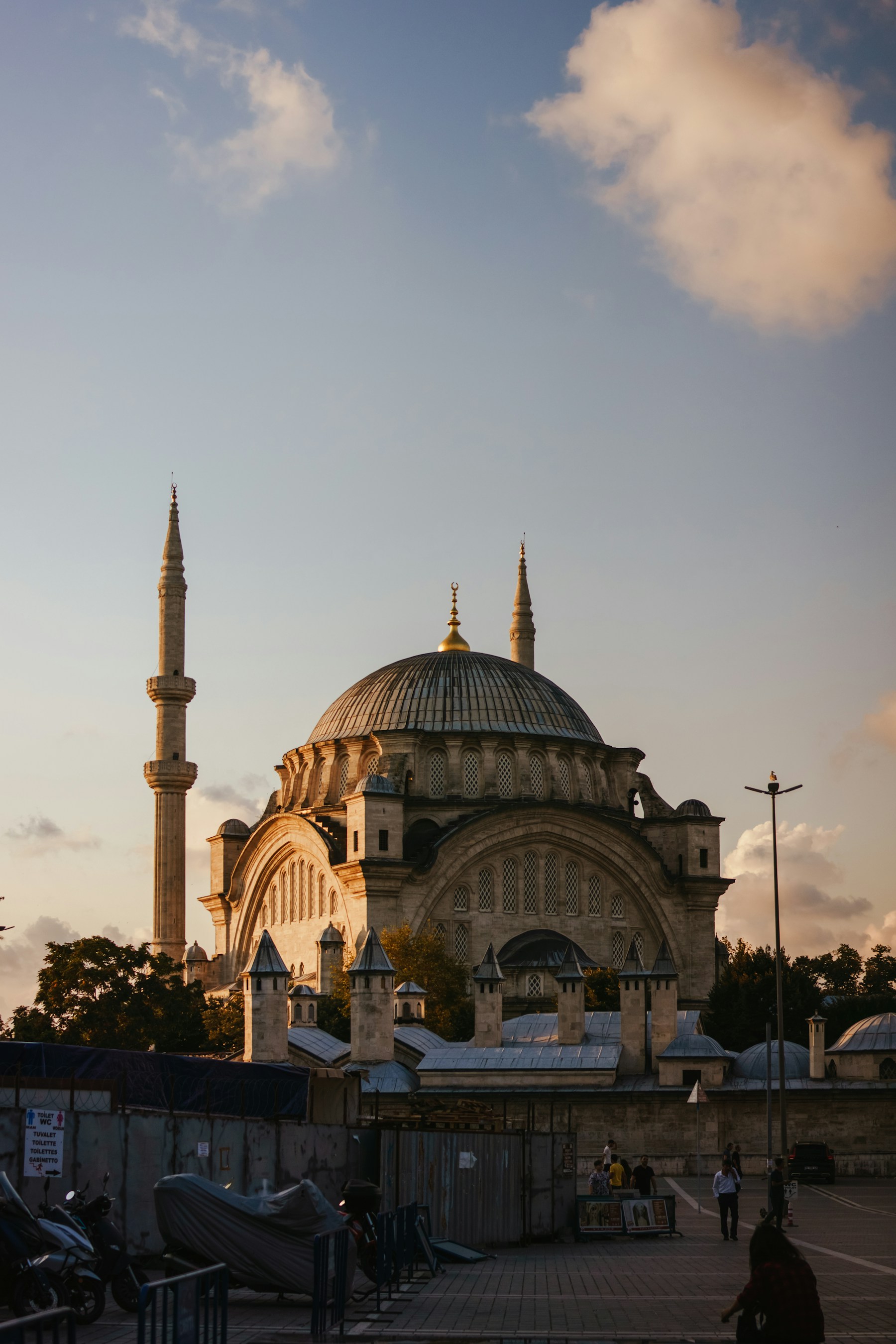
The dome should be read as the visible end of a chain rather than as a single object. Four great arches, pendentives, semi-domes, exedrae, piers, and side spaces all help the central volume stay legible. This system matters because Hagia Sophia is not a simple domed room like a circular rotunda. It is a basilican space transformed by a dome. The design joins longitudinal movement with centralized height, which is why the interior can feel both directional and cosmic.
Semi-domes extend the central space
The semi-domes keep the central dome from becoming isolated. They extend the dome's force along the building and make the interior expand in stages. A viewer looking from the nave toward the apse sees not one roof but a cascade of curved surfaces. This staged expansion is a design strategy. It softens the transition from human scale to imperial scale and makes the main space feel larger than a single measured volume.
Light is structural in the experience
Light is not just decoration in Hagia Sophia. The ring of windows around the dome, the side openings, and the glow on surfaces all change how structure is perceived. Light makes supports appear less solid and separates upper surfaces from lower mass. This is why descriptions of the dome often focus on floating or suspension. The effect is not magic. It is a careful relationship between opening, geometry, surface, and the viewer's body in the space.
The galleries change the section
The upper galleries make the interior more complex than a single floor view suggests. They create secondary routes, different sightlines, and a layered public section. From below, the galleries add depth and shadow to the side walls. From above, they let the visitor understand the dome and arches from closer range. This matters because Hagia Sophia is not only a volume to stand inside. It is a spatial system that changes with level, direction, and distance.
Byzantine and Ottoman elements share the room
The design today is inseparable from its layered religious use. Mosaics, marble revetment, calligraphic roundels, mihrab orientation, minarets outside, and later structural buttressing all participate in the current reading. A weak design analysis would describe these as competing decorations. A stronger analysis asks how different layers occupy the same great volume. Hagia Sophia's interior teaches that architecture can hold multiple regimes of image, ritual, and memory without becoming visually simple.
Design comparison
Compare Hagia Sophia with the Pantheon and St Paul's Cathedral. The Pantheon concentrates power into one ancient domed interior. St Paul's uses a layered dome to serve both interior worship and city skyline. Hagia Sophia is different because the dome transforms a basilican plan and then absorbs centuries of religious conversion and structural support. It is less a perfect object than a living section, where engineering, light, ritual, and historical change remain visible together.