guide
Hagia Sophia Facts: Dome, Justinian, and Istanbul Layers
The 537 date is the third beginning
The key fact about Hagia Sophia is that the famous building completed in 537 was not the first church on the site. It followed earlier structures destroyed by fire and revolt, including the church lost in the Nika revolt of 532. That matters because the present building was conceived as a larger and more ambitious answer to crisis. A reader should treat the date as a rebuilding fact, not only as a birth certificate. The architecture begins with replacement, imperial ambition, and the desire to make sacred space visible at a scale Constantinople had not seen before.
Justinian's commission shaped the scale
Hagia Sophia belongs to the reign of Emperor Justinian I, and that patronage explains the building's scale and confidence. It was not a quiet parish church. It was the main cathedral of Constantinople, built to carry imperial, liturgical, and urban meaning at once. The project gathered mathematics, engineering, materials, labor, and ceremony into one public statement. That context helps explain why the interior feels unusually vast: the building was meant to make political and sacred order spatially convincing.
The dome is the central fact
The central dome is the fact that makes Hagia Sophia legible even to a first-time viewer. It is not simply a roof over a square. It rises from a system of arches, pendentives, semi-domes, and side volumes that distribute force while expanding the interior visually. The dome appears to float because structure, light, and wall surface are organized to reduce the sense of heavy support. This is why a useful facts page must move quickly from date to section: the building's identity is structural as much as historical.
Pendentives make the transition visible
The pendentives are essential because they solve the geometric transition between the square bay below and the circular dome above. Visitors may not name them at first, but they can see the effect: the dome does not sit bluntly on four walls. It is carried through curved triangular surfaces and large arches into a broader spatial system. That transition is the architectural lesson. Hagia Sophia makes a technical solution feel like a continuous interior atmosphere.
The building carries more than one religion
Hagia Sophia's fabric records different religious and political lives. It began as a Byzantine cathedral, was converted into a mosque after the Ottoman conquest of Constantinople in 1453, later became a museum, and has again been used as a mosque. These changes are not abstract timeline notes. They are visible in the building through minarets, calligraphic roundels, mosaics, screens, floor use, and conservation debates. The building is layered because history kept changing the way the same structure was read.
The exterior and interior teach different facts
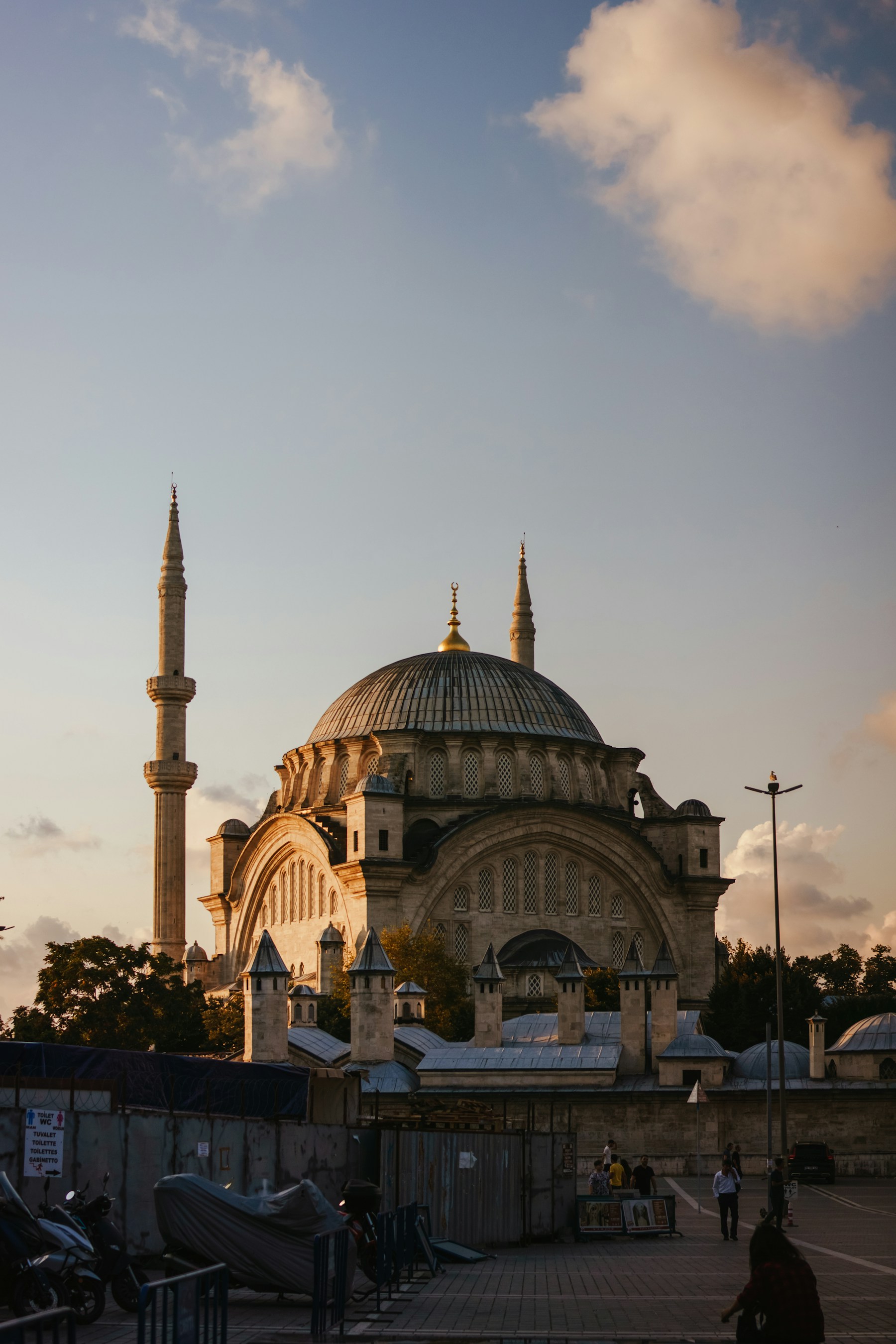
From outside, Hagia Sophia reads through dome, buttressing, minarets, mass, and its place in Istanbul's historic core. Inside, the reading shifts toward light, suspended space, galleries, marble, mosaics, calligraphy, and the dome's structural drama. Both views are necessary. An exterior-only reading can make the building look heavy and accumulated; an interior-only reading can hide the urban and Ottoman additions that shaped its current image. The facts are strongest when they connect the two.
What the facts should help you see
Use the basic facts as viewing tools. The 532-537 rebuilding explains urgency and ambition. Justinian explains imperial scale. Anthemios and Isidoros explain why geometry matters. The dome and pendentives explain the spatial system. The Ottoman conversion explains minarets and Islamic interior elements. The World Heritage context explains why the site is a public preservation question as well as a building to visit. Those facts make Hagia Sophia less generic: it becomes a single structure carrying many architectural lives.