guide
Guggenheim Museum Bilbao River and Atrium Visit Notes
Start across the river
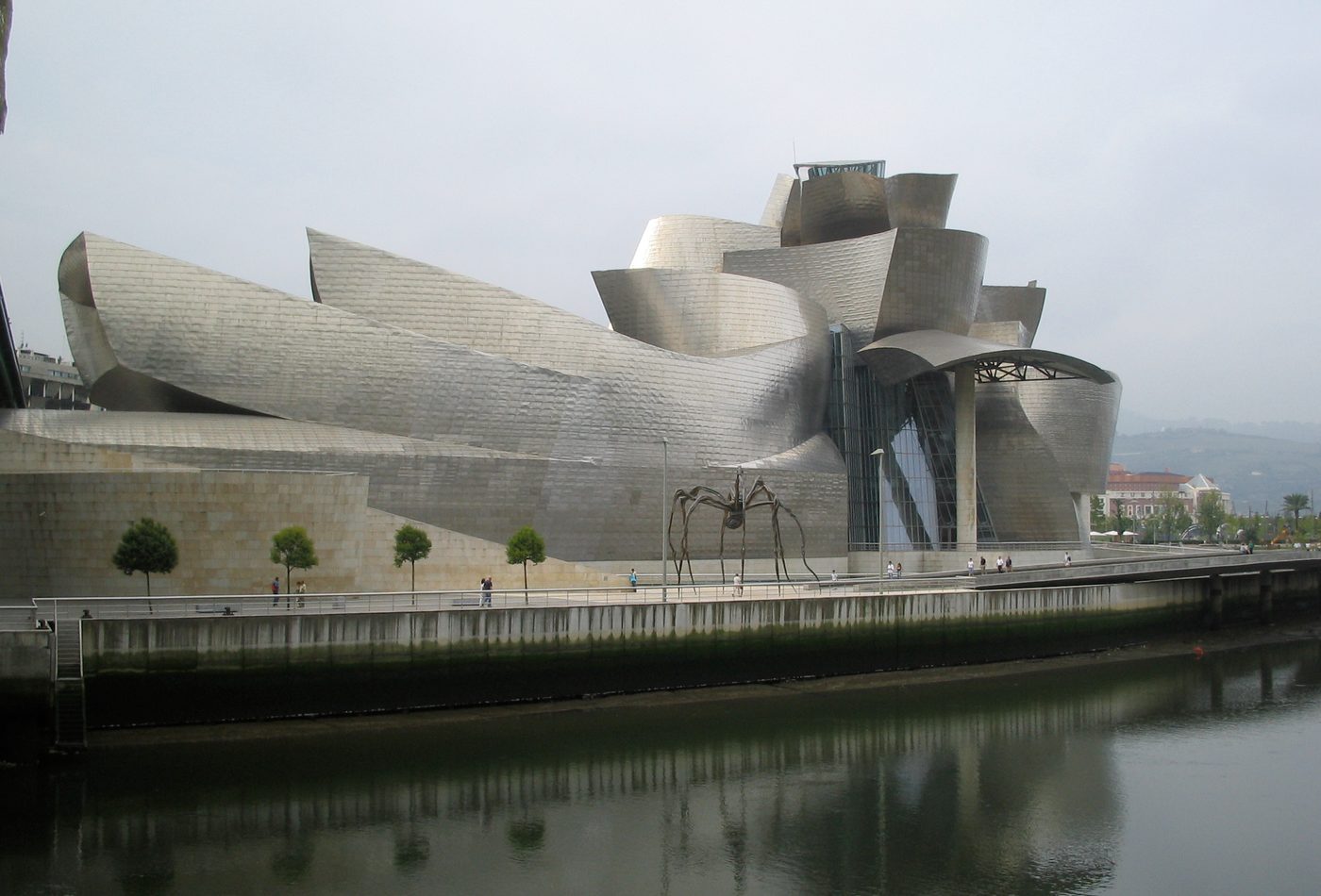
The best first read of Guggenheim Museum Bilbao is from across or along the river, where the building can be seen with water, bridge, and city fabric in the same view. This distance makes the museum's urban role clear before the surface detail takes over. The building was designed to be encountered as part of a riverfront transformation, so the visit should begin with context rather than with a close-up of titanium.
Walk the river edge slowly
After the wide view, move along the river edge and watch how the volumes change. The museum does not have one fixed front. Its metal forms fold, overlap, and turn toward different approaches. The walk is useful because it reveals the building as a sequence rather than a single image. Pause when the titanium, glass, water, and bridge structure enter the same frame. That is where the urban reading becomes strongest.
Look for the stone parts
Visitors often photograph the titanium and forget the limestone. Do the opposite for a few minutes. Look for the more grounded stone volumes and ask how they balance the reflective curves. The museum needs those heavier parts because the galleries and city-facing edges cannot all behave like metal waves. The contrast between limestone, glass, and titanium is one of the clearest ways to understand the design.
Use close detail as evidence
At close range, study the titanium panels as individual pieces rather than as one shiny surface. Notice panel scale, seams, color changes, and how light softens or sharpens the curves. This detail matters because it connects the building's global image to construction reality. The museum becomes more credible when the famous exterior is read through actual joints, edges, weathering, and material behavior.
Read the atrium if you go inside
If your visit includes the interior, use the atrium as the main architectural checkpoint. Stand where you can see stairs, bridges, lifts, gallery entries, light, and vertical volume at once. The atrium explains how the museum turns sculptural complexity into orientation. It also gives a different lesson from the exterior: the building is not only about image. It has to move people through art, height, light, and circulation.
Make three useful photographs
Make one riverfront photograph that includes city context, one close material photograph of titanium or limestone, and one circulation photograph if the interior is accessible. Those three images create a better architectural record than a single postcard angle. They show setting, surface, and movement. That is the minimum evidence needed to remember why the building is a museum, an urban project, and a construction achievement at the same time.
Compare after the visit
After studying the museum, compare it with Sydney Opera House, Dancing House, and Centre Pompidou. Each uses unusual form differently. Sydney turns roof geometry and harbor setting into civic image; Dancing House works at street-corner scale; Centre Pompidou externalizes public systems; Bilbao uses titanium surface and riverfront regeneration. That comparison keeps the visit from becoming only a story about the Bilbao effect and brings the attention back to architectural evidence.