guide
Florence Cathedral Facade, Dome, and Campanile Visit Notes
Begin with the skyline, then the piazza
A useful Florence Cathedral visit starts before the visitor reaches the facade. Look for the dome from streets, bridges, or higher viewpoints if possible, because the building's first architectural role is as a city marker. Then move into the piazza and let the scale change. The dome belongs to the skyline; the facade and campanile belong to close urban experience. Holding those two views together prevents the visit from becoming only a facade photograph.
Read the facade in layers
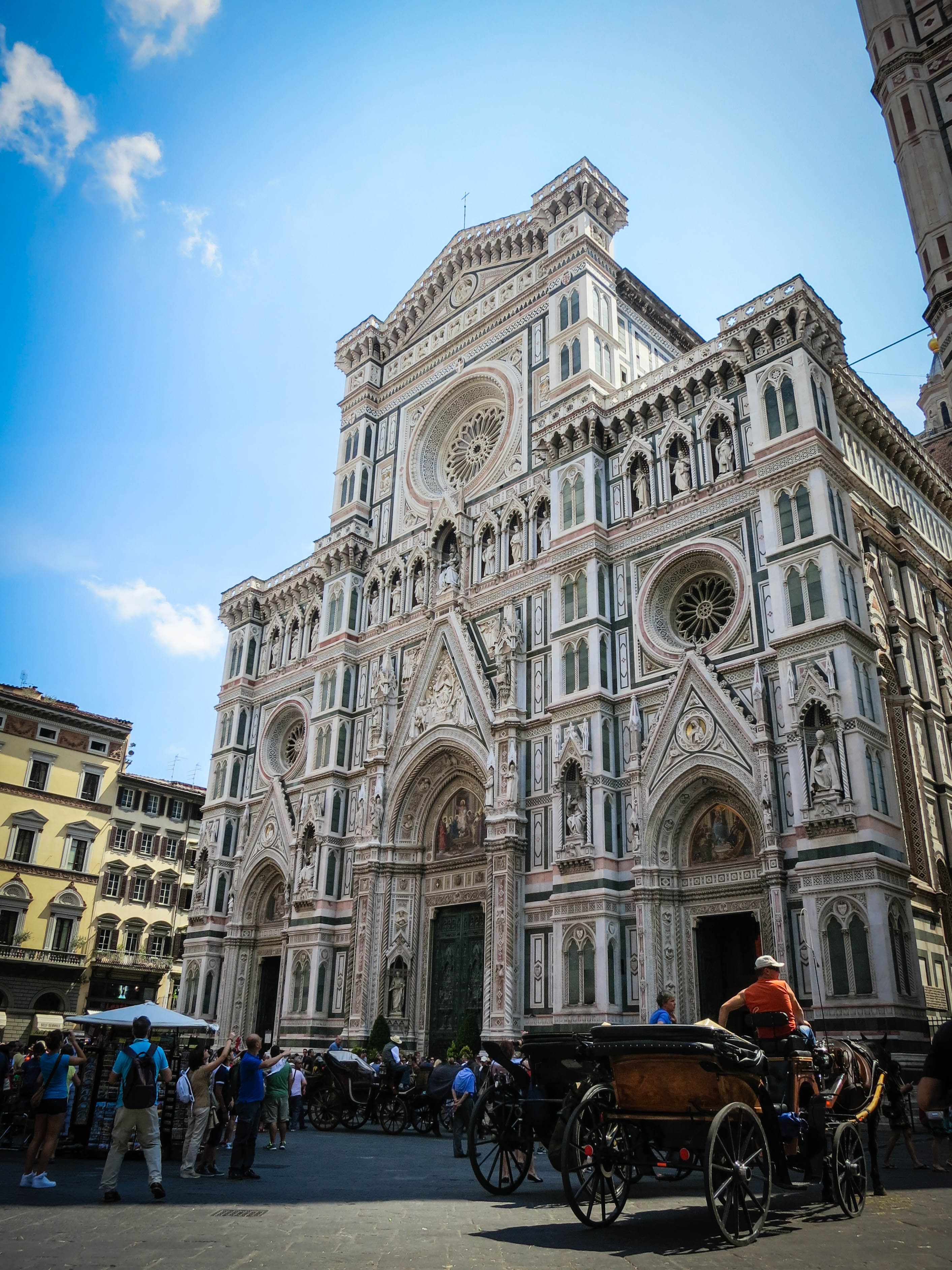
Stand far enough back to see the whole front, then move closer in stages. First read the overall triangular gables, rose windows, portals, and vertical divisions. Then look for the color changes in the marble and how they frame smaller pieces. The facade can feel visually crowded, but that density is the point. It turns a giant cathedral wall into a sequence of readable zones. The goal is to see order inside abundance.
Do not ignore the campanile
Giotto's campanile is not a side accessory. It changes the entire piazza composition by giving the cathedral complex a separate vertical body. Compare its patterned surface with the cathedral facade, then step back and see how tower, church, and dome compete and cooperate. This comparison helps visitors understand the complex as a civic ensemble rather than a single building with a famous roof.
Use the dome as a construction clue
When the dome is visible, study its octagonal geometry, ribs, lantern, tile color, and relationship to the lower cathedral body. The dome should not be treated only as a scenic cap. It is evidence of a difficult structural problem solved at city scale. Ask how it rises from the crossing, how it changes the skyline, and how it differs from ancient dome models such as the Pantheon.
Let the threshold change your scale
If you enter the cathedral, use the threshold as a scale reset. The busy piazza and patterned facade create one kind of visual pressure, while the interior volume asks for slower orientation. Look for the length of the nave, the pull toward the crossing, and the way the dome becomes a spatial event rather than only an exterior silhouette. Even a short interior visit should connect the outside image to the building's section.
Make four kinds of photographs
Build a small architectural record rather than collecting one postcard shot. Take one city or skyline image with the dome visible, one piazza image showing facade and campanile together, one close facade image of marble pattern or portal detail, and one oblique view that shows how the cathedral body turns in the tight urban fabric. Those four views preserve city role, complex relationship, surface craft, and massing.
Look for old and later work together
A strong visit should notice that the building is layered across time. The present facade, medieval body, dome, campanile, sculptural details, paving, crowds, and conservation work do not all belong to one moment. Instead of looking for a pure original state, ask how the cathedral became the object now seen in the city. That question makes the building more interesting and avoids the common mistake of treating a long project as a single style sample.
Compare after the visit
After studying Florence Cathedral, compare it with the Pantheon for dome logic, with St Peter's Basilica for later religious and urban monumentality, and with Milan Cathedral for another Italian cathedral where surface detail and civic identity meet. These comparisons help separate what belongs to Florence specifically from what belongs to broader questions of domes, facades, and cathedral-scale city image.
The visit test
A useful visit should leave four answers. You should be able to explain how the dome changes Florence's skyline, how the facade organizes visual density, how the campanile changes the complex, and why the building cannot be described with one style label. If those answers are clear, Florence Cathedral has moved from a tourist landmark into architectural evidence.