guide
Florence Cathedral Facts: Dome, Facade, and Civic Scale
The first fact is a cathedral complex
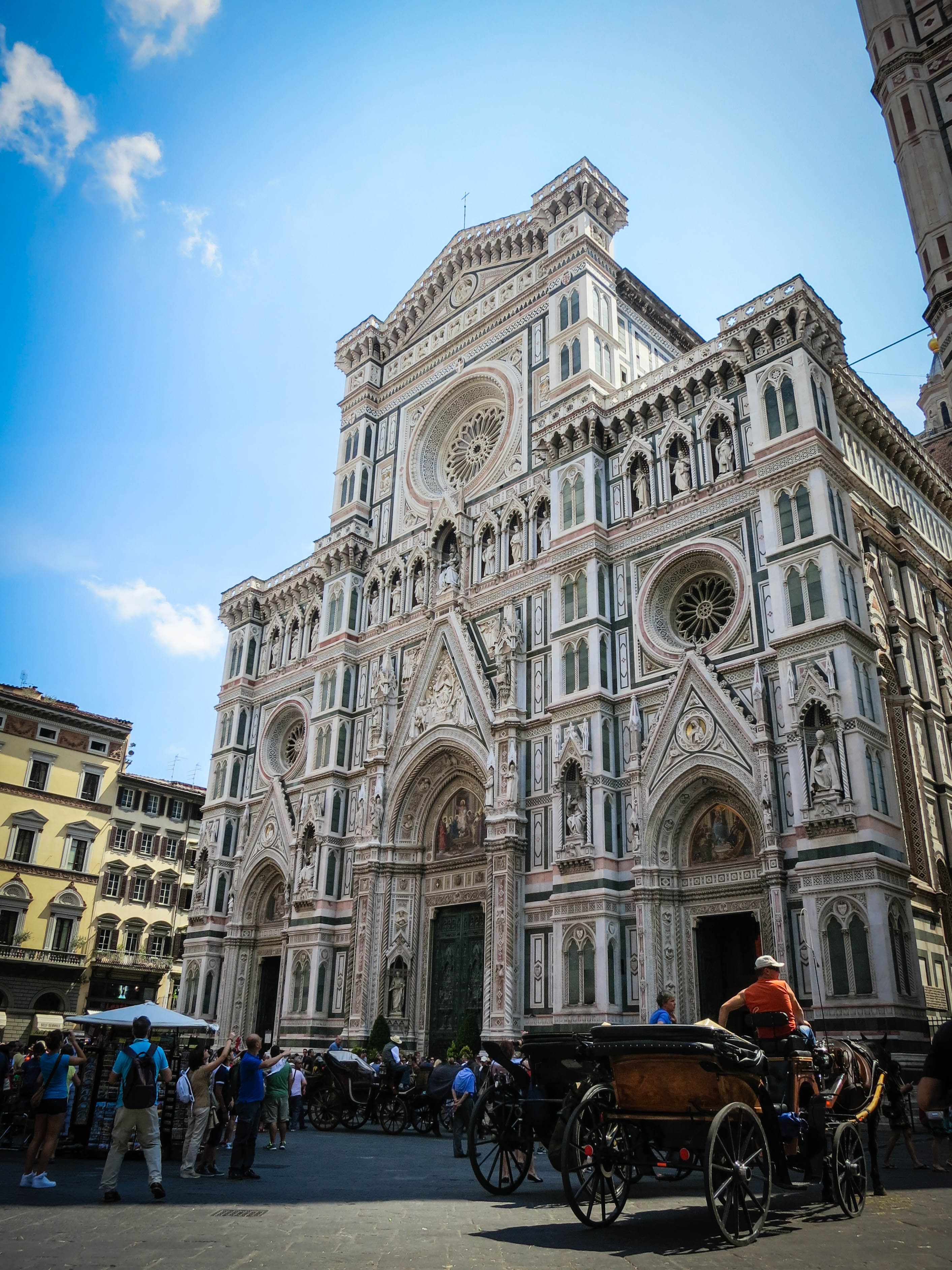
Florence Cathedral should not be read as only one front facade or one famous dome. It is part of a larger cathedral complex that includes Santa Maria del Fiore, Giotto's campanile, the baptistery nearby, the piazza around it, and the city fabric that presses close to the monument. That matters because the building works by accumulation. Facade, nave, dome, bell tower, pavement, crowd movement, and urban approach all contribute to the architectural experience.
The dome changed the city profile
The date marker of 1436 points toward the completion of Brunelleschi's dome, the feature that made the cathedral's long story into a visible city event. The dome is not only a roof over a crossing. It gives Florence a dominant skyline form and turns technical construction into civic identity. From a distance, the cathedral is often recognized by the octagonal dome before the facade is seen. That priority matters: the building is an urban landmark before it becomes a close decorative surface.
The facade is a material lesson
The colored marble facade makes Florence Cathedral unusually readable at close range. Green, white, and pink stone patterns turn the surface into a dense system of frames, panels, arches, gables, sculpture niches, and rose windows. The pattern is not merely ornamental. It slows the eye and breaks a very large wall into human-scale pieces. A visitor who studies the facade can see how material contrast gives rhythm to a building that might otherwise feel overwhelmingly large.
Gothic body, Renaissance dome
The atlas marks the building with both Gothic and Renaissance style readings, and that overlap is the useful fact. The cathedral body carries pointed arches, vertical emphasis, decorative complexity, and medieval urban ambition. The dome, by contrast, belongs to a Renaissance story of geometry, engineering, and civic confidence. The building is therefore not a clean example of one style. Its importance comes from the way a long medieval project was completed by a dome that changed architectural history.
Brick, stone, and marble do different work
The main materials recorded here are marble, brick, and stone, but they should not be treated as a flat list. Brick is central to the great dome and its construction logic. Stone gives structure and urban mass. Marble turns the public-facing surfaces into a patterned civic skin. Those materials explain three scales at once: engineering above, wall and pier stability within, and decorative surface at the pedestrian edge. The building's material intelligence depends on that division of work.
The baptistery and campanile keep the facts grounded
The cathedral's immediate neighbors make the basic facts more concrete. The baptistery in front and the campanile beside the cathedral create a public ensemble rather than a single isolated monument. This matters for orientation: visitors often understand the complex by moving between separate but related buildings. The cathedral facade answers the baptistery across the piazza, while the campanile gives the complex a vertical measure before the dome takes over the skyline.
What the facts should help you see
A useful Florence Cathedral fact sheet should leave a reader with a sequence: first, the dome on the skyline; second, the cathedral complex in the piazza; third, the polychrome facade and rose windows; fourth, the relationship between medieval body and Renaissance dome. Those facts turn the building from a single famous image into a set of architectural relationships. The cathedral is large enough to overwhelm a quick visitor, so facts should function as a route through scale.
Why it belongs in the core atlas
Florence Cathedral belongs in the public core because it connects engineering, image, and city identity in one legible monument. Compare it with the Pantheon for dome precedent, with St Peter's Basilica for later dome-based civic and religious ambition, and with Milan Cathedral for another Italian monument where scale and surface detail shape public memory. The comparison shows that a cathedral can be an engineering problem, a city symbol, and a close-looking exercise at the same time.