guide
Florence Cathedral History Across Gothic and Renaissance Work
The history is a long project, not one date
Florence Cathedral cannot be reduced to 1436 even though that date is essential for the dome and consecration. The building began in the late thirteenth century, developed through medieval civic ambition, reached a major technical climax with Brunelleschi's dome, and received its present facade much later. That long chronology matters because the cathedral is a record of changing priorities. It shows a city returning to the same public monument across generations.
Medieval Florence built for civic identity
The cathedral was never only a church interior. It was a civic statement in a competitive Italian city, a project that connected religion, guild culture, public pride, craft, and urban image. Its scale and location made it part of Florence's self-presentation. When a city builds at this size, architecture becomes an argument about collective capacity. The cathedral says that worship, city government, artisanship, and public memory can converge in one monumental center.
The dome became a historical turning point
The dome's importance comes from the way it solved a highly visible problem. The crossing needed a roof that could span an enormous space without relying on a conventional timber centering strategy at that scale. Brunelleschi's solution became famous because it joined technical invention to civic drama. The result was not just a completed building. It was a historical episode in which engineering, competition, experiment, and public identity became inseparable.
Workshops and institutions made the monument possible
The cathedral should also be understood through the institutions and crafts that sustained it. Large medieval and Renaissance building projects depended on administrators, patrons, guilds, quarrying, transport, masons, sculptors, carpenters, metalworkers, and long financial commitment. The finished monument can hide that labor. Florence Cathedral is historically useful because its scale makes the organization behind architecture visible: a city had to keep choosing the building over time.
The facade belongs to another historical layer
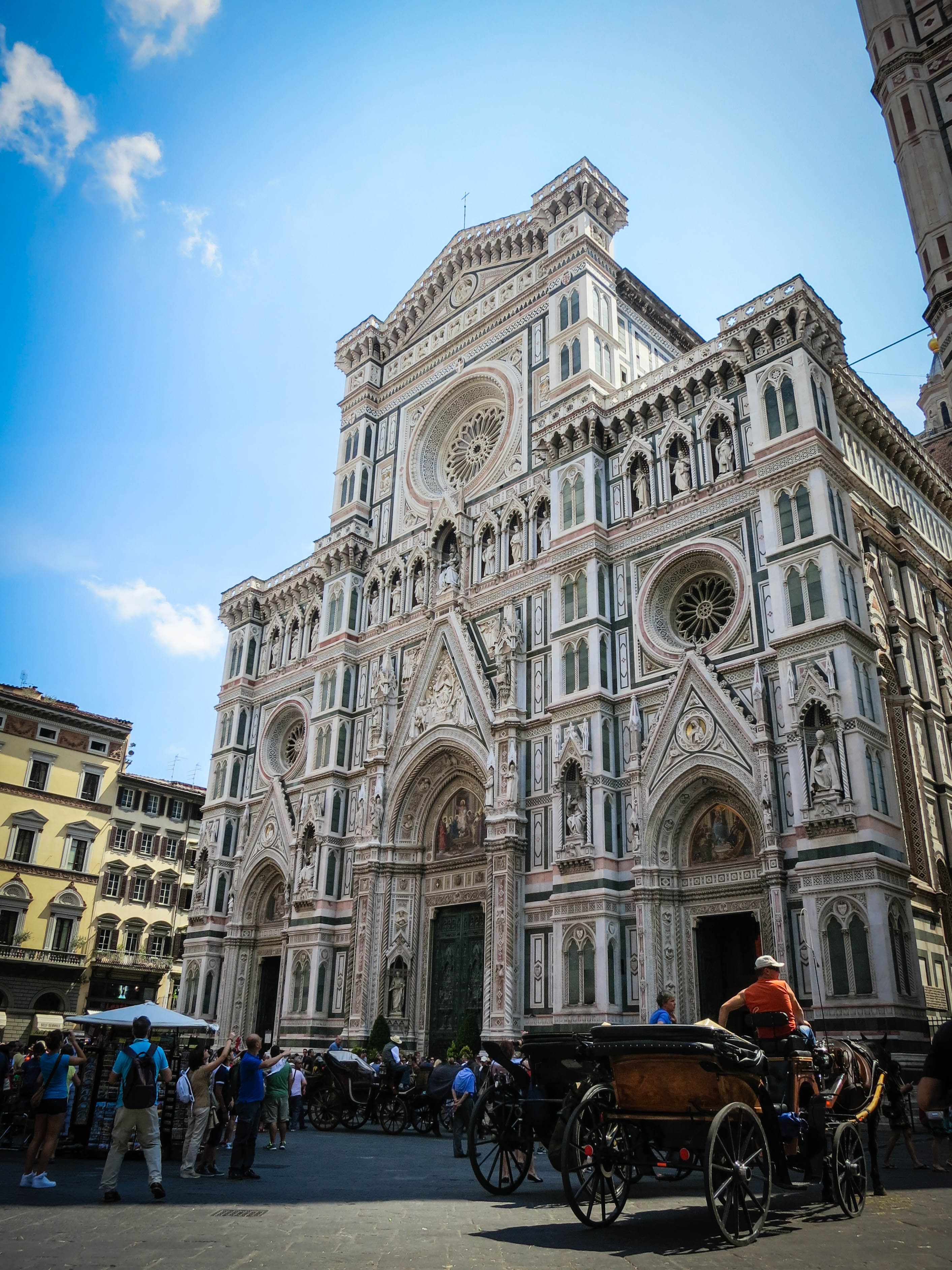
The front most visitors photograph today is not a simple medieval survivor. The present polychrome facade belongs to a later completion, which means the visitor is seeing different historical layers at once. That should not make the facade less important. It makes it more instructive. The building's public image is partly the result of later interpretation, taste, and completion. Florence Cathedral teaches that monuments are often assembled across time, not frozen at first construction.
The building shaped Renaissance memory
Florence Cathedral became part of the story people tell about the Renaissance because the dome made ingenuity visible. It was tied to geometry, construction knowledge, urban pride, and the idea that architecture could recover and surpass ancient ambition. The Pantheon is a useful comparison because it shows a great earlier dome, but Florence Cathedral's dome belongs to a different historical moment: a city using new methods to solve a public problem left by medieval scale. That is why the dome is remembered as both a technical achievement and a civic narrative about Florence itself.
Tourism can flatten the history
The cathedral's fame can make it too easy to see only the postcard: red dome, patterned facade, busy piazza. A better historical reading keeps the tensions visible. The building is religious and civic, medieval and Renaissance, local and globally famous, technical and decorative. It has been shaped by original construction, later completion, restoration, crowd use, and constant reproduction in images. Those tensions are not clutter. They are the reason the building remains historically alive, and why a guide should resist reducing it to a beautiful skyline object.
The historical lesson
Florence Cathedral teaches that architectural history is often the history of unfinished problems being inherited, transformed, and solved. Later generations did not erase the earlier cathedral; they completed and reinterpreted it. That makes the building especially useful for readers who think monuments appear fully formed. Here, the public masterpiece is the result of time, risk, technical ambition, civic pride, and a willingness to let new work speak to old work in public.