guide
Aqua Tower History in Chicago's High-Rise Lineage
A Chicago tower after a long high-rise tradition
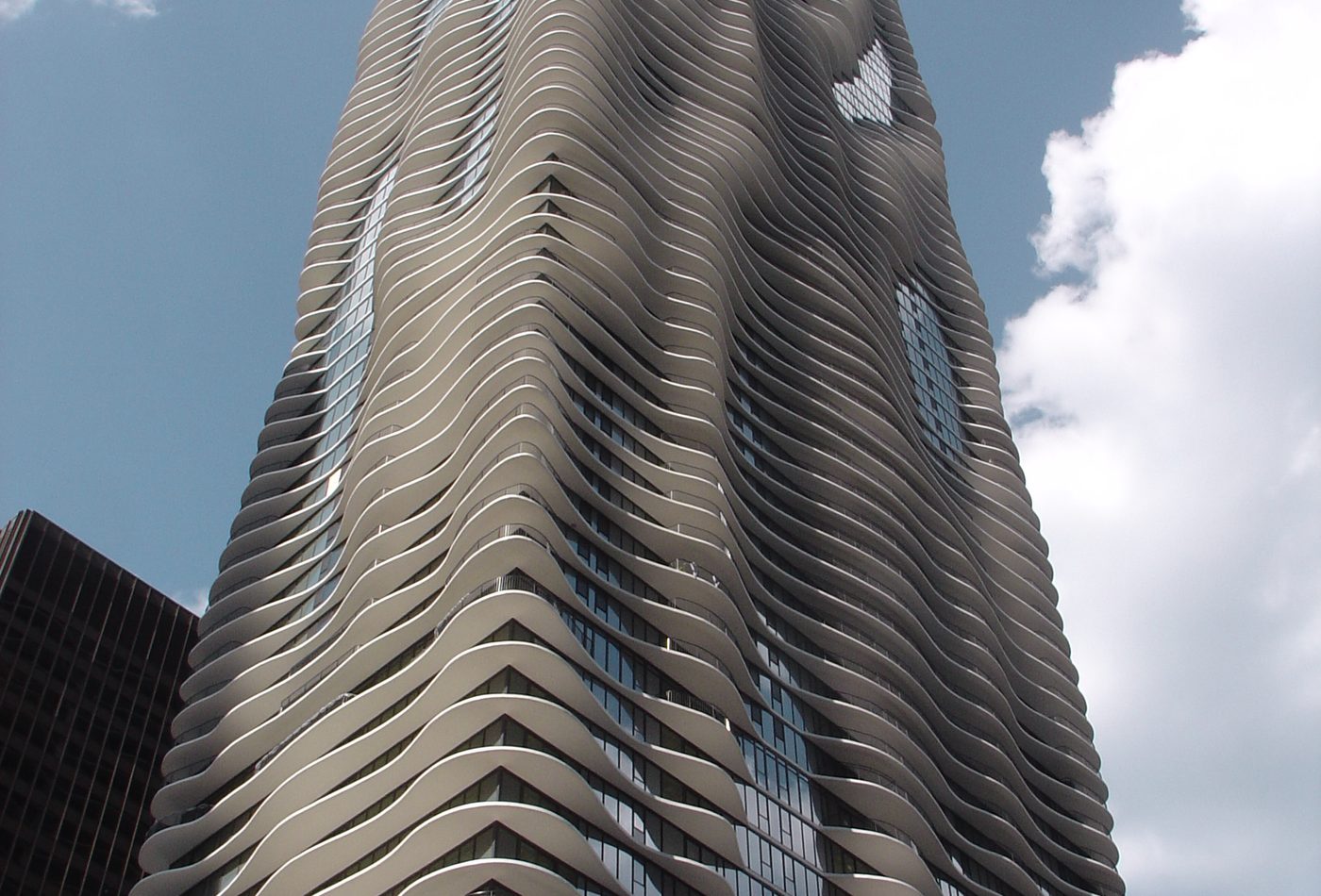
Aqua Tower matters historically because it enters a city where the tall building is already a deep tradition. Chicago does not need a tower to prove that high-rise construction is possible. The question for Aqua was different: how can a contemporary tower add something meaningful to a skyline shaped by steel frames, glass walls, commercial towers, residential slabs, and architectural experimentation? Its answer was to make the edge of the floor plate carry the building's identity. That gives the project a place in Chicago's high-rise story without merely repeating older structural expression.
Lakeshore East changed the setting
The building also belongs to the history of Lakeshore East as a planned urban district. Its importance is not only that it is tall or photogenic. It helps mark a part of central Chicago where residential life, hotel use, park space, retail, streets, and access to water are compressed into a new urban image. Aqua's rippling surface gives that district a recognizable vertical marker. The building is therefore both a private mixed-use development and a public-facing piece of city identity.
Studio Gang's authorship shifted the conversation
Studio Gang and Jeanne Gang are central to the building's historical meaning because Aqua made a broad public audience notice a different kind of high-rise authorship. The tower did not rely only on height, corporate branding, or a spectacular top. It used a pragmatic residential element, the balcony, as the source of expression. That move helped make the project part of a wider discussion about how contemporary architecture can connect environmental reasoning, user experience, and strong visual identity.
The building made balcony design visible
Balconies are often treated as secondary amenities in residential buildings. Aqua changed that reading by making balcony shape the first thing most people remember. Historically, this matters because it turns an ordinary domestic feature into an urban-scale subject. The balcony is no longer just a private outdoor ledge. It becomes a public silhouette, a shading device, a sign of unit difference, and a way to soften the apparent rigidity of a high-rise. That is why the building is studied beyond Chicago.
Its popularity also creates a risk
Aqua's image is easy to imitate poorly. Once the wave becomes famous, later projects can borrow curved balcony edges without carrying the same relationship to view, exposure, use, and environmental performance. That is the main historical risk: the building can be reduced to a style cue. A good history page should resist that reduction. Aqua is important not because a tower can be made wavy, but because the wave is tied to real high-rise questions.
A useful historical comparison
Compare Aqua with older Chicago high-rise lessons and with newer global icons. Older Chicago towers often make structure, frame, or commercial order visible. The Shard makes skyline sharpness and taper visible. Marina Bay Sands makes a whole resort diagram visible. Aqua makes the inhabited edge visible. That historical placement is more useful than treating it as a novelty image. The building records a moment when high-rise design could be judged through facade performance, resident experience, environmental awareness, and city image together.