guide
Notre-Dame de Paris Design: Buttresses, Rose Windows, and Nave
The design is a system, not a mood
Notre-Dame is often described through atmosphere: dark stone, colored glass, towers, bells, and memory. The more useful design reading starts with system. The cathedral uses Gothic structure to make height, light, procession, and exterior support visible. Pointed arches and ribbed vaults organize the interior span. Flying buttresses carry forces outside the wall line. Windows and rose windows then become possible at a scale that earlier heavy walls could not easily support.
Flying buttresses make the exterior honest
The flying buttresses are not merely picturesque arms around the building. They let the exterior show how the building handles thrust. Their value is partly structural and partly educational: they turn hidden forces into visible form. When a reader sees the buttresses, the cathedral stops being a stone shell and starts becoming a diagram of load, counter-load, vertical ambition, and the desire to open walls for light.
Rose windows connect geometry and devotion
The rose windows carry more than decorative value. They bring geometry, color, scale, and religious storytelling into one architectural device. In design terms, they also show the Gothic bargain: structure works hard so that the wall can become a field of glass and image. The best reading does not isolate the rose window as a symbol. It asks what had to happen structurally and spatially for such a window to become central to the facade and transept experience.
The west facade slows the eye
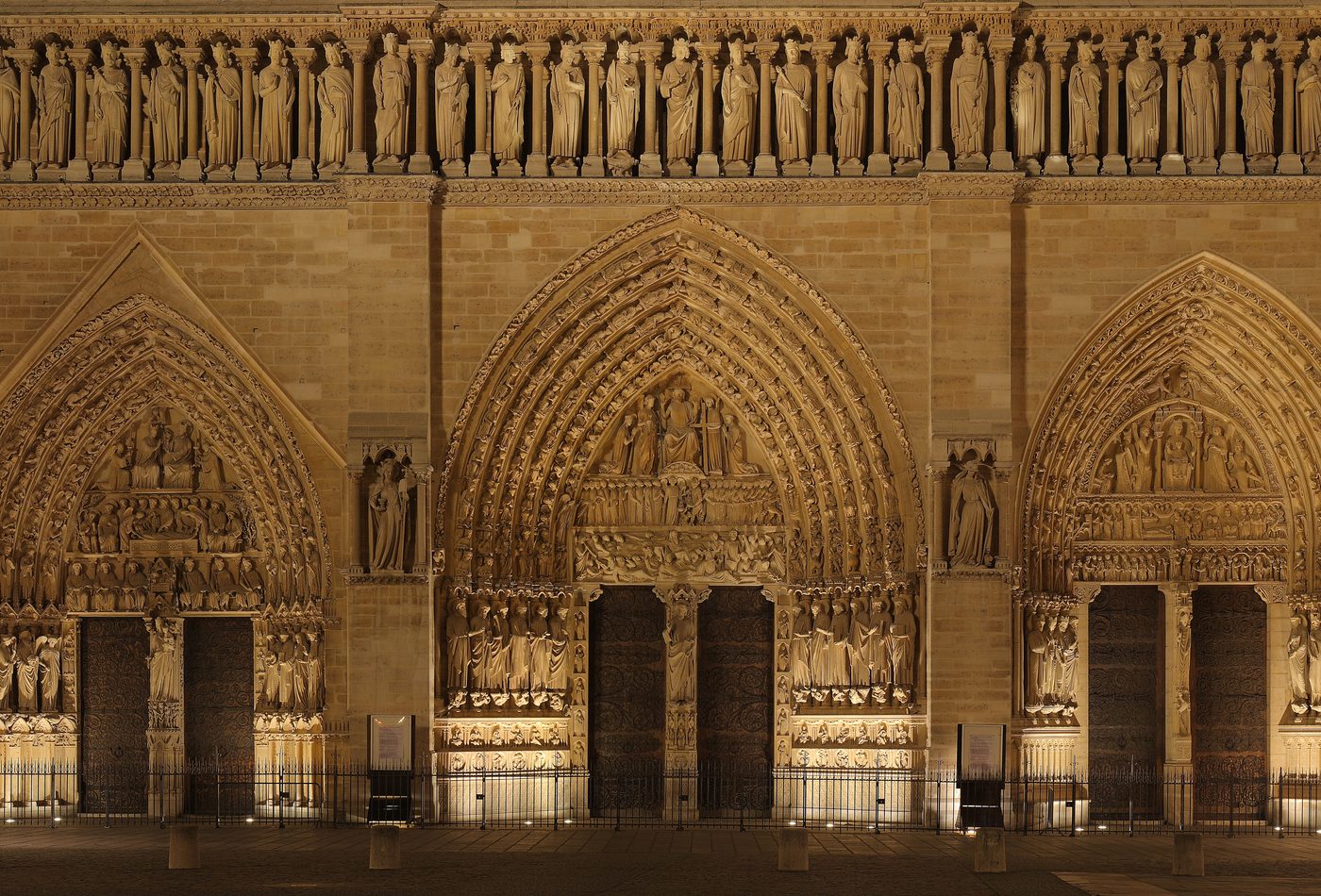
The west front has a strong legibility because it is ordered in layers. Portals establish the human threshold; sculptural bands and galleries give the facade a civic and religious narrative; the rose window forms a central pause; the towers pull the composition upward without dissolving the front into pure verticality. That balance is why the facade can feel monumental at a distance and still reward close study at the doors, carvings, and window level.
Material contrast is quieter than the silhouette
Limestone, stained glass, timber, metal, and restoration materials each carry a different architectural role. Stone gives mass and carved depth. Glass changes the interior relationship to light. Timber roof structure, especially after the 2019 fire and reconstruction, reminds readers that a cathedral is not only stone permanence. It also depends on concealed craft, maintenance, and replacement. Notre-Dame's material story is therefore less static than its iconic image suggests.
Restoration changed the design reading
Viollet-le-Duc's nineteenth-century restoration and the post-2019 reconstruction both shape how the building is seen now. A design analysis should not pretend that the cathedral is a frozen medieval object. Restoration can clarify, repair, interpret, and sometimes remake the evidence. Notre-Dame is important because those layers remain public. The building asks readers to distinguish medieval structure, later restoration imagination, and contemporary conservation without separating them into unrelated stories.
The design mistake to avoid
The common mistake is to treat Notre-Dame as a generic Gothic cathedral because the vocabulary is familiar. That misses the exact lesson. The building's power comes from the way site, facade order, external support, light, restoration, and public memory reinforce one another. Its design is not only a set of Gothic features. It is a readable urban machine for height, light, gathering, image, and repair.