guide
Notre-Dame de Paris Facts: Gothic Structure and Reopening Context
The island setting is not background
Notre-Dame de Paris should first be read through its position on the Ile de la Cite. The cathedral does not sit beside Paris as a detached monument; it occupies one of the city's most charged river sites. From the Seine, bridges, quays, and narrow approaches, the towers and roofline become part of the geography of central Paris. That site fact matters because the building's authority comes from urban placement as much as from Gothic detail.
The date points to a long medieval build
The atlas year of 1345 is useful as a shorthand for the cathedral's medieval completion, but it should not make the building feel like a single-moment object. Notre-Dame belongs to a long campaign that began in the twelfth century and continued across generations. That time span explains why a visitor sees both a unified Gothic idea and many layered decisions. The building is a cathedral, a construction sequence, and a city memory at once.
Gothic structure turns mass into height and light
The essential architectural fact is the Gothic system: pointed arches, ribbed vaults, flying buttresses, large windows, and a strong vertical order. These parts are not separate checklist items. They work together to shift load, open wall surfaces, bring light into the interior, and make the exterior read as a structure under tension. Notre-Dame is useful because the system remains legible from outside even before the visitor enters the nave.
The west facade teaches order
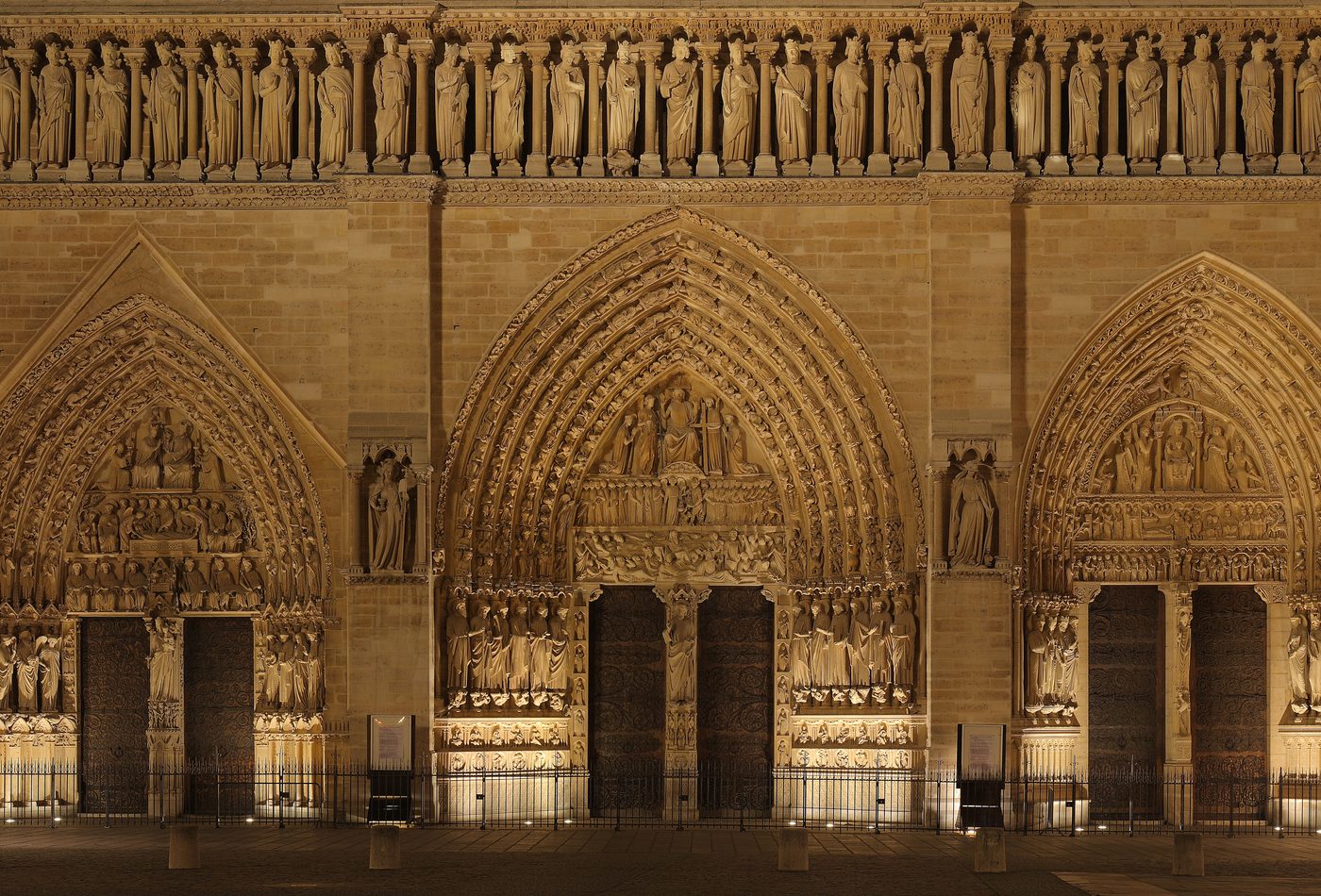
The west facade is more than a famous front. It organizes portals, sculpture, rose window, galleries, and two towers into a controlled vertical and horizontal composition. The facade helps readers understand why Gothic architecture is not only about height. It is also about hierarchy: where the eye starts, how it climbs, which bands slow it down, and how the towers hold the whole front in balance.
Restoration is part of the building's fact base
Notre-Dame cannot be explained only as a medieval survivor. The nineteenth-century restoration associated with Eugene Viollet-le-Duc reshaped how modern viewers imagine the cathedral, especially through repaired sculpture, renewed details, and the spire that became central to its silhouette. That restoration layer does not make the building less authentic as a subject. It makes the cathedral a record of medieval ambition, modern interpretation, damage, repair, and public attachment.
The 2019 fire made structure visible again
The fire of 2019 changed the way many people see Notre-Dame. It exposed the vulnerability of timber roof structure, stone vaulting, lead roofscape, scaffolding, and restoration logistics that are usually hidden behind the image of a finished monument. The reopening in December 2024 made the cathedral part of a contemporary restoration story, not only a medieval history story. That is why the recent event belongs in an architecture facts page.
What the facts should help you see
A strong first reading connects four facts: island site, Gothic load path, facade order, and restoration memory. Those anchors stop the page from becoming a list of dates and famous features. They tell a reader where to stand mentally: look at the cathedral as a public object on the Seine, a structural system of height and light, a facade composition, and a building repeatedly remade by care, damage, and repair.