guide
Mont Saint-Michel Abbey Design: Causeway, Village, and Abbey Crown
The design is a vertical compression
Mont Saint-Michel Abbey works because the island compresses many architectural roles into a steep vertical body. At the bottom are arrival, walls, lanes, services, and settlement. Above them rise terraces, monastic rooms, church volumes, and the abbey crown. The design is not a single facade but a vertical ordering of public and sacred space. This compression makes the whole island read like one building even though it is an accumulated ensemble.
The causeway frames the composition
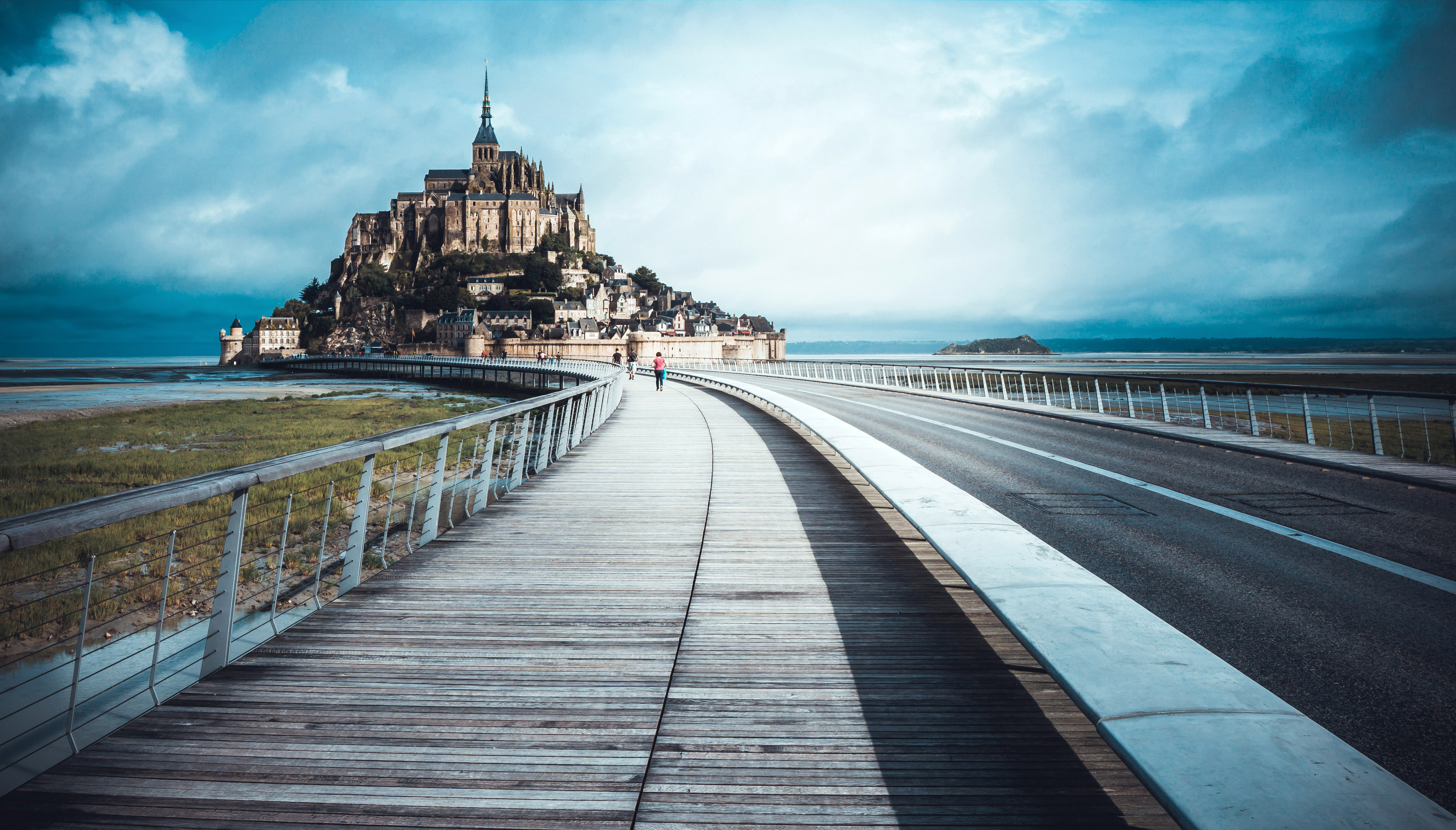
The long approach is part of the design reading. From the causeway, the island appears as a distant mass before details become visible. That slow reveal is powerful because it lets the viewer read the profile as a whole: rock below, settlement in the middle, abbey above. The route creates anticipation and scale. It also prevents the monument from becoming only a close-up object; the first design lesson is distance.
Rock and masonry work as one mass
The strongest design effect is the way rock and masonry seem to belong to the same upward movement. The island base anchors the settlement, while walls and buildings extend the natural form rather than replacing it. This is different from a palace on flat ground. Here the architecture appears to grow from the terrain. The boundary between natural pedestal and built form is intentionally hard to separate in the long view.
The village climb organizes perception
The village route is not a secondary tourist corridor. It organizes perception by breaking the monument into stages. Narrow lanes compress the body, stairs redirect the eye, and small openings reveal water, walls, or roofs. Each stage changes the visitor's scale. By the time the abbey is reached, the climb has already explained the building's hierarchy. The design depends on movement from crowded lower space toward more exposed upper space.
The abbey crown gives the island a direction
The abbey does not simply sit at the top; it gives the entire island a visual direction. Rooflines, towers, buttressed masses, and church volumes draw attention upward. This upward pull is why the island can be recognized from far away. Without the crown, the settlement would still be dramatic, but it would lose the clear vertical target that organizes the composition. The abbey turns topography into an architectural ascent.
Tide changes the design reading
The tide is a design condition even though it is not built by architects. Water, mudflat, and distance change how the island is framed. At some moments the place feels surrounded and remote; at others the exposed bay makes the approach seem longer and more horizontal. That changing frame affects the architecture's meaning. Mont Saint-Michel is therefore not a fixed object in a fixed foreground. It is a monument whose setting keeps editing the view.
The design lesson
The design lesson is that a powerful landmark can be an accumulated section rather than a clean object. Mont Saint-Michel combines route, rock, defense, settlement, worship, and horizon into one legible mass. Its drama comes from the fact that no single part explains the whole. The architecture becomes memorable because each layer supports the next, and because the visitor can read that layering through approach, climb, and long-distance silhouette.