guide
Dancing House River Corner Visit Notes
Approach it as a corner building
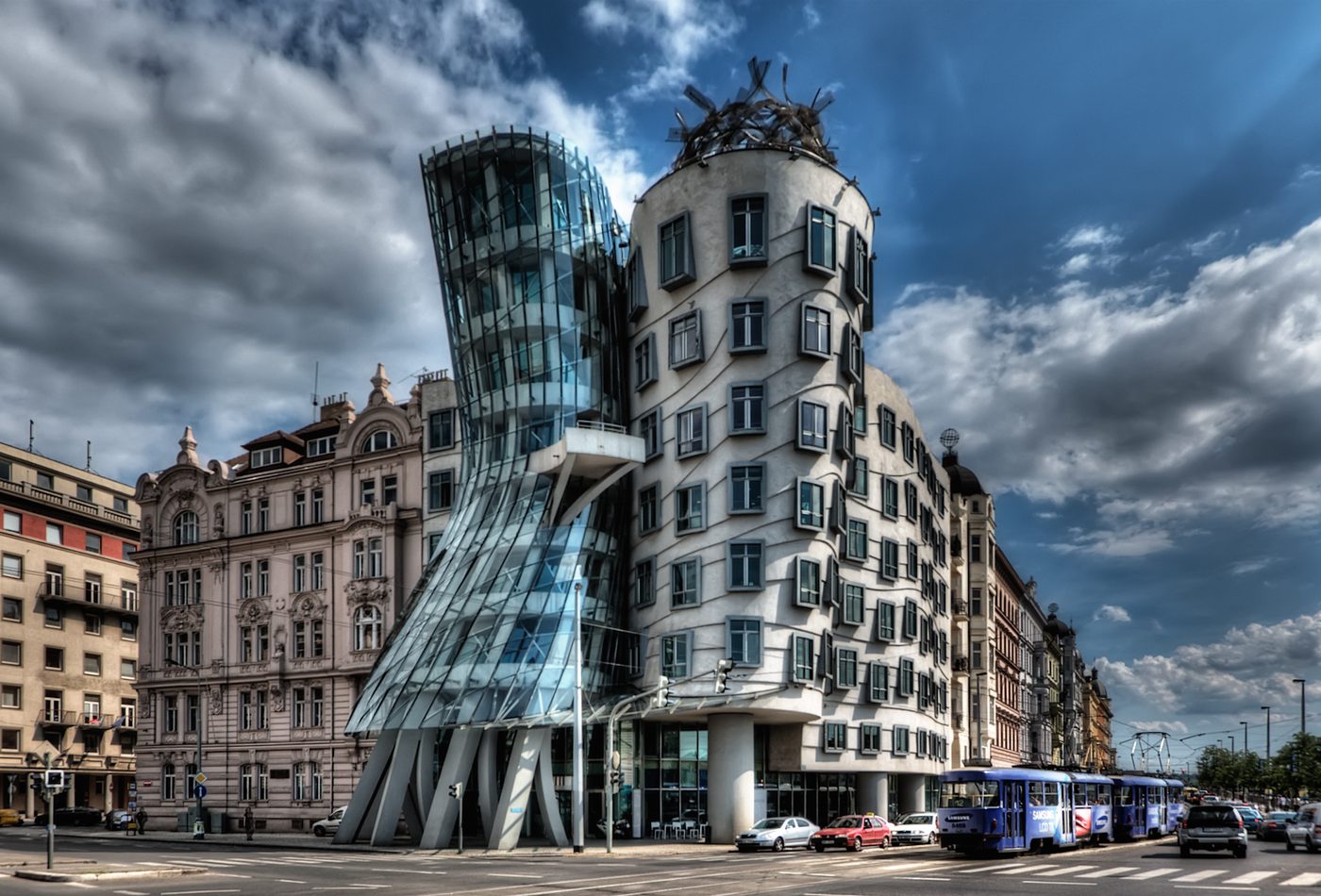
Start by reading Dancing House from the street corner, not as a freestanding sculpture. The building's energy comes from how it turns the corner and interrupts a more regular urban edge. Stand far enough back to see both volumes at once. The useful question is not simply whether the building looks like dancers. The better question is how movement is created within the limits of a compact city site.
Compare the two bodies
Look separately at the glass tower and the heavier tower. The glass body appears compressed and transparent; the other body feels more anchored but still distorted through its windows and surface. Move your eye back and forth between them. The building becomes clearer when the viewer treats it as a duet of different weights, not as one strange facade.
Watch the windows
The windows are a practical way into the design. They reveal how ordinary office repetition has been bent into a more animated rhythm. From some angles the window lines seem to lean or slide; from others they reconnect with the street wall. This is where the building's theatrical image meets its everyday use. A visitor who studies only the overall silhouette misses that smaller discipline.
Use the surrounding buildings as evidence
Dancing House needs its neighbors. The contrast with more regular facades makes the movement sharper. Take a moment to look at the surrounding street before looking back at the corner. The building's effect depends on a visual before and after: the city sets an expectation, then Dancing House bends it. That relationship is more informative than an isolated close-up.
Check how it meets the sidewalk
At street level, look for the moments where the expressive image has to become a usable building. The base, entries, glass edge, and heavier wall all have to negotiate pedestrian scale. This is where the visit becomes more than a photograph. A successful reading should explain how the building keeps its theatrical identity while still making a corner, holding a frontage, and giving the passerby enough clues to understand where the volumes begin and end.
Make three useful photographs
First, make a wide corner view that includes neighboring buildings. Second, make a vertical view of the glass tower's compressed waist. Third, isolate the angled windows or the top detail of the heavier body. These three photographs preserve context, figure, and detail. They also prevent the visit from becoming only a repetition of the most common postcard angle.
What to compare next
After visiting or studying Dancing House, compare it with Guggenheim Museum Bilbao, Centre Pompidou, or Sydney Opera House. Each makes a public argument through a form that was not initially neutral. Dancing House is smaller and more street-bound than those examples, but that is exactly why it is useful. It shows that architectural memorability can come from a precise corner condition, not only from monumental scale.
Slow-looking route
Give the visit a simple order: street context first, whole corner second, glass body third, solid body fourth, window rhythm last. This route keeps the reading architectural. It lets the visitor move from city contrast to form, then from form to detail. The building becomes more convincing when its apparent joke is tested against actual facade decisions.