guide
Vienna Secession Building: facade motto
Before you go
Vienna Secession Building is a exhibition hall in Vienna, Austria. The atlas records it with a year marker of 1898, a material palette of plaster, gilded metal, and glass, and a style reading of Art Nouveau Architecture. That framing matters because the building is not just a name on a list; it is a visible case study in how architecture turns structure, program, site, and public memory into a built object. This visiting guide treats the building as something to observe carefully, whether you are planning a trip, checking a map, or studying photos before arrival. The map position near 48.2007, 16.3654 is a practical anchor, but the real goal is to know what to look for once the building is in view.
First view strategy
Start with distance. A famous building often makes its strongest argument before you are close enough to see details. Look at how Vienna Secession Building sits in Vienna: whether it dominates a skyline, frames a street, opens to a plaza, meets water, or hides within a dense fabric. The first view explains the building's public role.
Close-up observations
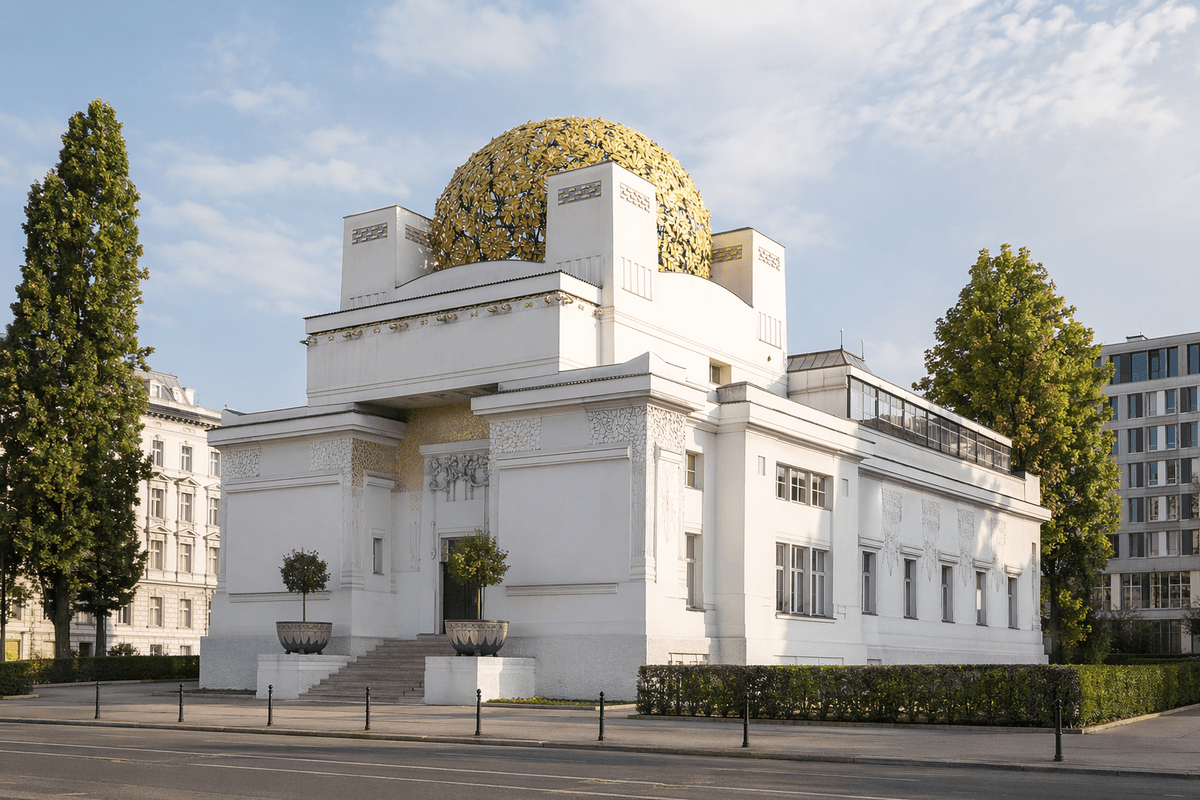
Once close, shift attention to golden dome, flat white walls, and ornamental entrance. These are the clues that help a visitor move beyond taking a quick picture. Details reveal scale, construction, texture, and rhythm. They also show where the designer wanted the body to slow down, look upward, enter, turn, or compare one surface with another.
Photo and sketch angles
For photos or sketches, try one view that captures the whole form, one view that isolates a material detail, and one view that shows the building's relationship to its surroundings. That three-part record is more useful than a single postcard angle because it preserves object, construction, and city context. For Vienna Secession Building, the material palette of plaster, gilded metal, and glass will often decide which light conditions make the details legible.
Reading the style on site
Use the style tags Art Nouveau Architecture as a checklist, not as a final answer. Ask which features are obvious in person and which only become clear through explanation. A good visit should test the label against what the building actually does: how it handles entrance, structure, light, mass, ornament, and movement.
What to open next
After visiting or studying Vienna Secession Building, open related landmarks such as Karlskirche, and Hundertwasserhaus. The comparison helps separate site-specific impressions from broader architectural patterns. It also gives the visitor a useful next step instead of ending the experience with a single landmark page.
A practical reading path
Keep three checks together as you read Vienna Secession Building: the city view, the material evidence close to hand, and the sibling guide that answers the next question. Start with golden dome, flat white walls, and ornamental entrance, then test whether those clues connect to plaster, gilded metal, and glass, the building's role as a exhibition hall, and related works such as Karlskirche, and Hundertwasserhaus. That route turns the page into a usable study path instead of a one-off description.
Where this guide fits
This guide focuses on one way to read Vienna Secession Building. Use the related links when the question changes from "what is it" to "how is it designed," "why is it famous," or "what should I notice in person." Keeping those questions separate makes the building easier to study without turning the page into a long undirected summary.