guide
Hundertwasserhaus: anti-grid facade and organic housing
Design reading
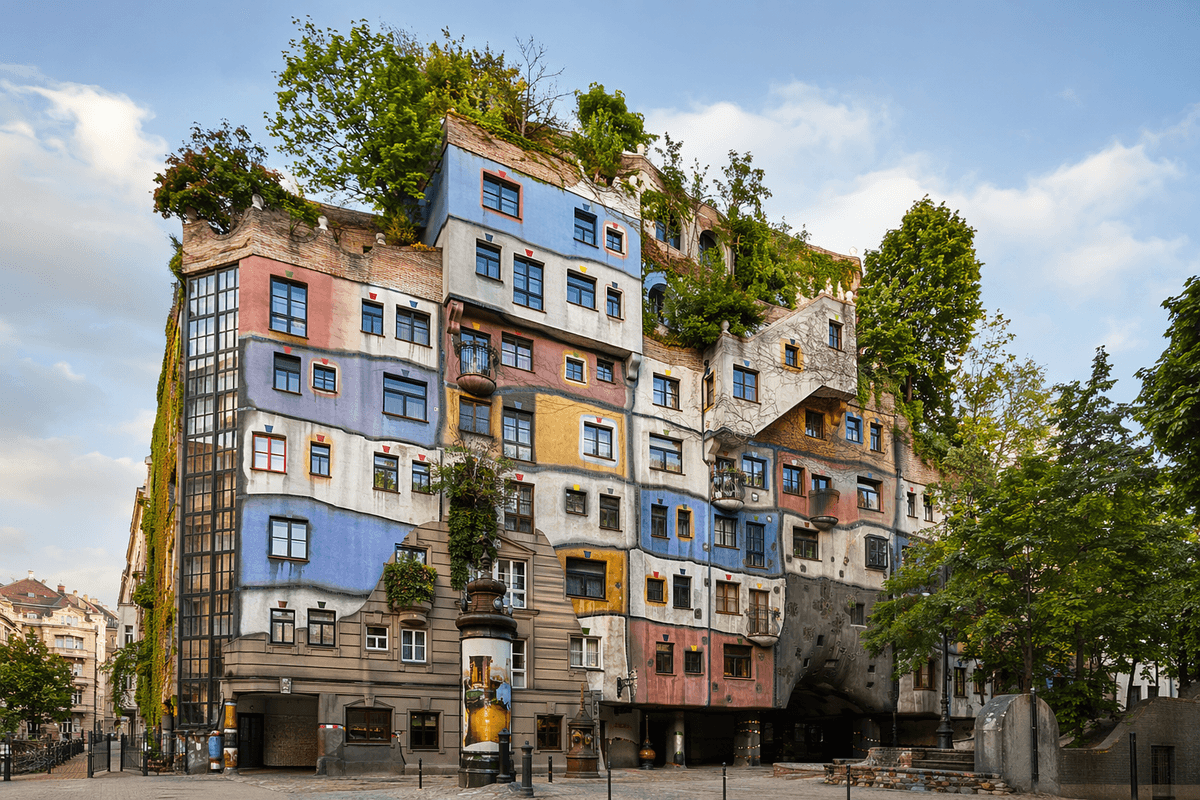
Hundertwasserhaus is a apartment building in Vienna, Austria. The atlas records it with a year marker of 1985, a material palette of brick, tile, plaster, and vegetation, and a style reading of Postmodern Architecture, and Organic Architecture. That framing matters because the building is not just a name on a list; it is a visible case study in how architecture turns structure, program, site, and public memory into a built object. A design analysis starts by asking what the building makes legible. Some landmarks foreground structure; others foreground surface, procession, symbolism, or skyline impact. For Hundertwasserhaus, the most useful first move is to compare the overall form with the smaller details that guide the eye.
Form and massing
The building's form should be read as a sequence, not a frozen icon. Notice how the main volume is approached, where the eye is pulled, and whether the silhouette feels heavy, light, horizontal, vertical, symmetrical, fragmented, or fluid. Those choices affect how Hundertwasserhaus is remembered. A memorable massing strategy lets a building work at map scale, street scale, and photo scale at the same time.
Structure and envelope
The material set of brick, tile, plaster, and vegetation gives clues about structure and envelope. Ask whether the materials are doing visible work or creating a surface over hidden systems. In many famous buildings, the envelope becomes the public argument: glass can signal transparency, stone can signal permanence, steel can signal span and lightness, and concrete can signal mass or plastic form. The facade is therefore evidence, not mere wrapping.
Detail hierarchy
The key details to study are uneven window rhythm, roof planting, and bright facade colors. A strong detail hierarchy lets visitors understand what matters first and what rewards a slower look. Some details work as orientation devices, some express construction, and some carry cultural meaning. The best analysis asks how those details cooperate instead of treating them as isolated visual features.
Urban design effect
Hundertwasserhaus also has an urban role in Vienna. It may frame a plaza, terminate an axis, create a skyline marker, concentrate visitors, or transform a waterfront, campus, or district. The design is therefore not only an object. It is a set of relationships among approach, view, threshold, public space, and memory.
How to compare it
Compare Hundertwasserhaus with Vienna Secession Building, and Rijksmuseum. The comparison should focus on form, material logic, public role, and how each project handles visibility. This is more useful than ranking landmarks because it turns a single building into a method for reading architecture elsewhere.
A practical reading path
Keep three checks together as you read Hundertwasserhaus: the city view, the material evidence close to hand, and the sibling guide that answers the next question. Start with uneven window rhythm, roof planting, and bright facade colors, then test whether those clues connect to brick, tile, plaster, and vegetation, the building's role as a apartment building, and related works such as Vienna Secession Building, and Rijksmuseum. That route turns the page into a usable study path instead of a one-off description.
Where this guide fits
This guide focuses on one way to read Hundertwasserhaus. Use the related links when the question changes from "what is it" to "how is it designed," "why is it famous," or "what should I notice in person." Keeping those questions separate makes the building easier to study without turning the page into a long undirected summary.